

Hydraulics ·
Custom Pump Impellers and Replacement Rotors – Water, Oil and Liquid Pump Guide
Configure a custom replacement impeller for small water, oil and liquid pumps. Learn how to measure the rotor, select blade geometry, fit a D shaft, choose materials, balance the part and download or order the 3D-printed impeller.
⚙️ Configure a custom pump impeller online
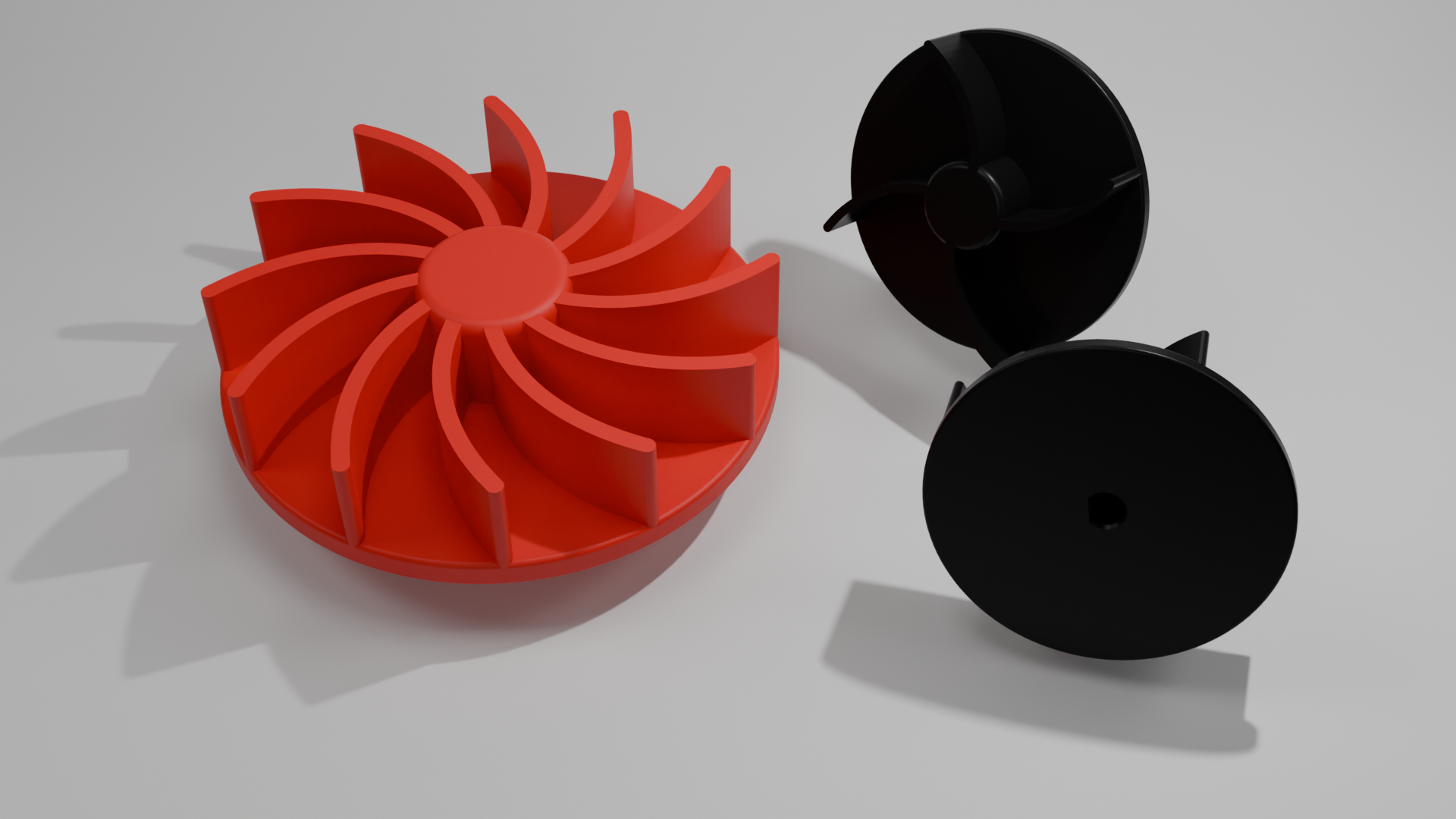
The original pump impeller is broken, worn out or no longer available as a spare part? Your water, oil or liquid pump uses a D-shaped motor shaft and no standard impeller fits the housing? The parametric pump impeller from BuildYour3D lets you create a custom semi-open rotor directly in your browser without CAD knowledge.
- Measure the original impeller, pump housing and shaft.
- Enter the impeller outside diameter and back-plate thickness.
- Select blade count, blade height and blade curvature.
- Enter the nominal D-shaft diameter.
- Check the generated 3D preview and dimensions.
- Download the STL or continue to the 3D-print order flow.
What is a pump impeller?
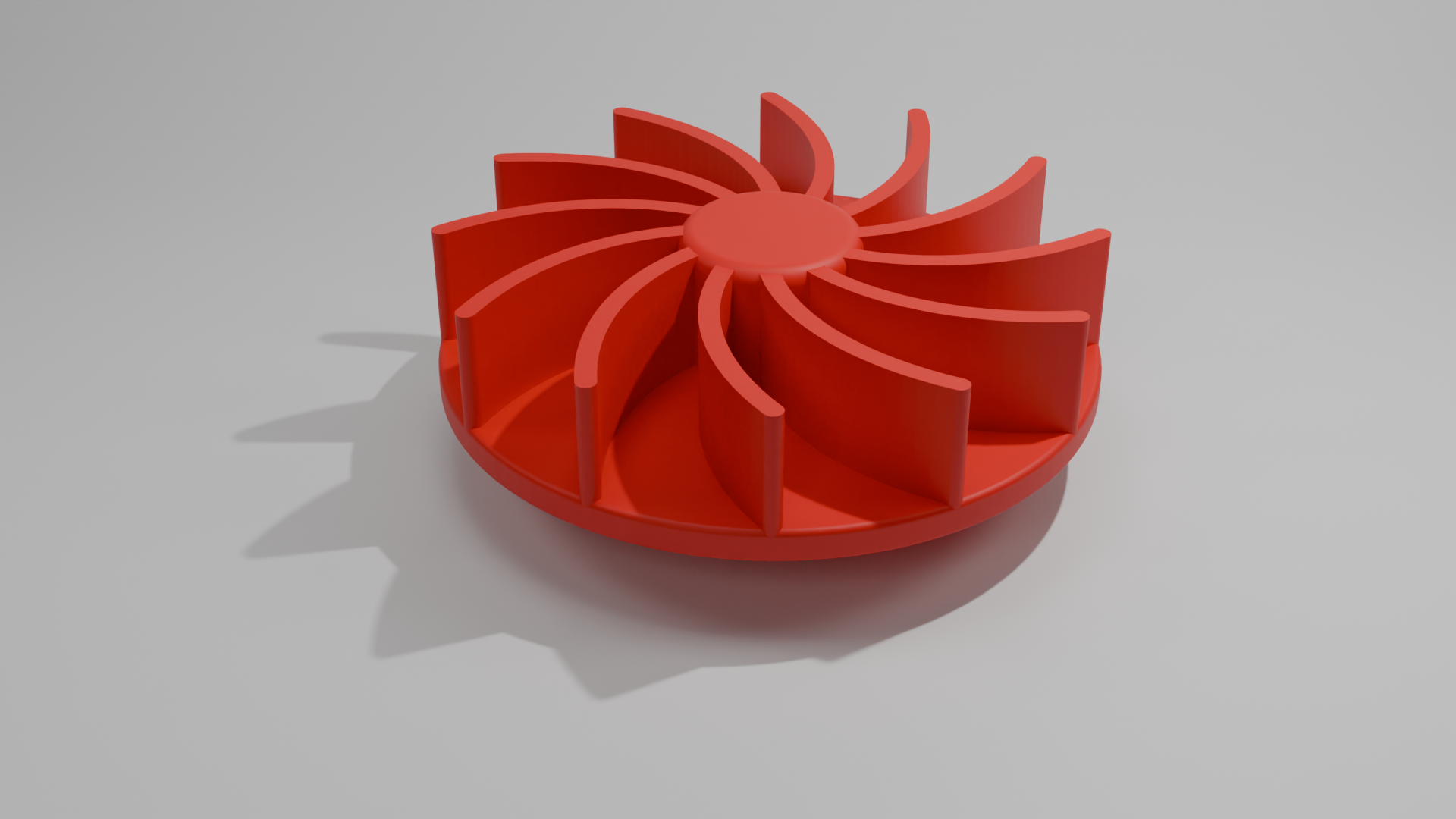
A pump impeller—also called a pump rotor, pump wheel or centrifugal rotor—is the rotating component that transfers mechanical energy from the motor shaft into the pumped fluid. Its blades accelerate water, oil, coolant or another liquid and create the flow required by the pump system.
The configurable model is a semi-open impeller. It has a closed rear back plate, a central hub and forward-facing curved blades. The hub remains closed at the front while the D-shaped shaft socket is inserted from the rear.
When is a custom replacement impeller useful?
Small pumps often fail because the impeller cracks, wears or loses its shaft fit while the motor and housing remain usable. Manufacturers may not sell the rotor separately, or the pump may be too old for original spare parts.
A configurable replacement impeller is especially useful for:
- broken or worn pump blades;
- a loose or rounded shaft socket;
- obsolete water or oil pumps;
- small centrifugal and circulation pumps;
- coolant pumps on workshop equipment;
- aquarium and model-engineering pumps;
- custom pump housings;
- test rigs comparing blade geometries;
- small DC motors with D-shaped shafts.
Real search intent behind custom pump impellers
People searching for this type of model usually have a specific repair, prototyping or replacement problem. Common search queries include:
- replacement pump impeller
- custom pump impeller
- water pump impeller replacement
- oil pump impeller
- centrifugal pump rotor replacement
- D-shaft pump impeller
- 8 mm D-shaft impeller
- 3D printed pump impeller
- pump impeller STL
- small water pump spare part
- coolant pump impeller
- aquarium pump rotor replacement
The configurator addresses that intent directly: instead of searching for a random catalogue part, the geometry can be matched to the available pump housing and motor shaft.
Which dimensions can be configured?
The product focuses on six essential inputs. Hub size, blade thickness, fillets, front wall, lead-in chamfer and bore clearance are calculated automatically.
1. Impeller outside diameter
The outside diameter defines the radial size inside the pump housing. It must be smaller than the available internal diameter. Too little clearance can cause rubbing or seizure, while excessive clearance can reduce hydraulic performance.
2. Back-plate thickness
The rear plate supports the blades and stiffens the rotor. A thicker plate can improve rigidity but also requires more axial space and adds rotating mass.
3. Number of blades
Blade count affects flow channels, load distribution, smoothness, sound and motor load. More blades do not automatically produce more flow. For a replacement part, matching the original blade count is usually the safest starting point.
4. Blade height
Blade height defines the axial depth of the flow passages. It must fit the available housing space. An impeller that is too tall may rub against the cover, while one that is too short may not use the available hydraulic section effectively.
5. Blade curvature and rotation
The curvature value controls the swept blade shape. Changing the sign mirrors the blades and therefore changes the intended direction of rotation. A mismatch between motor rotation and blade curvature can greatly reduce pump performance.
6. Nominal D-shaft diameter
The rear socket is generated for a D-shaped motor or pump shaft. The flat transmits torque more positively than a round bore alone. The model adds a small automatic manufacturing allowance.
D-shaft pump impeller design
D-shaped shafts are common on small DC motors, compact pump drives and gearmotors. The flattened side reduces slipping and provides simple mechanical torque transfer.
Before configuring the model, measure:
- the largest shaft diameter;
- the distance from the flat to the opposite curved side;
- available insertion depth;
- shaft orientation;
- required axial clearance;
- whether the original part used glue, a press fit or another retainer.
The current model uses an automatically calculated D-flat and a rear assembly chamfer. Very unusual shafts may require further geometry checks.
How to measure an existing pump impeller
Outside diameter
Measure across two opposite blade tips. If blades are damaged, the pump housing can provide an additional reference, but sufficient running clearance must still be included.
Overall height
Overall height is determined by the back plate and blade height. Measure the remaining axial gap to the housing cover.
Hub and shaft area
Measure the actual motor shaft with calipers. A worn or enlarged old bore is not a reliable reference for the original nominal shaft size.
Blade count and curvature
Count the blades and take a straight-on photograph of the original rotor. Record the motor direction from a clearly defined viewing side.
Radial and axial clearance
The impeller must not touch the housing, but too much clearance may reduce pumping efficiency. Consider print tolerance, thermal expansion and shaft movement.
Why blade curvature and rotation matter
Curved blades guide the fluid differently from straight radial blades. Depending on the direction of rotation, the same curve can act as backward- or forward-swept geometry.
An incorrect combination can result in:
- reduced flow rate;
- poor pressure development;
- higher turbulence;
- unexpected motor current;
- cavitation or air entrainment;
- excessive noise and vibration.
For a replacement part, reproduce the original curvature and rotation whenever possible.
How blade count changes pump behaviour
Blade count is an engineering parameter, not only a visual choice. Fewer passages can be wider and more tolerant of debris. More blades may create smoother energy transfer but also increase blockage and friction.
If you change blade count from the original, treat the result as an experiment and compare flow, motor current, temperature, sound and vibration.
Semi-open impeller: benefits and limitations
A semi-open impeller has a rear plate but no full front shroud over the blades.
Possible benefits include:
- simpler manufacturing and 3D printing;
- easy visual inspection;
- lower part volume;
- potentially better tolerance of some particles.
Possible limitations include:
- greater sensitivity to axial clearance;
- different hydraulic behaviour from a closed impeller;
- not a universal replacement for every pump type.
Configure the pump impeller online instead of drawing it in CAD
Creating curved blades, a hub and a D-shaped socket from scratch can take significant CAD work. The online configurator reduces the process to six understandable inputs.
The model automatically calculates:
- hub diameter;
- hub height;
- blade thickness;
- blade-to-hub overlap;
- blade-to-back-plate overlap;
- rounded plate and hub edges;
- closed front hub wall;
- D-shaped bore clearance;
- rear insertion chamfer.
Benefits of the pump impeller configurator
- ✅ Adjustable outside diameter
- ✅ Adjustable back-plate thickness
- ✅ Configurable blade count
- ✅ Adjustable blade height and curvature
- ✅ Positive or negative rotation geometry
- ✅ Custom nominal D-shaft diameter
- ✅ Automatically calculated hub and blade thickness
- ✅ Browser-based 3D preview
- ✅ No CAD software required
- ✅ STL download or 3D-print ordering
Download the STL and print the impeller yourself
After configuration, the STL is generated from the selected parameters and can be opened in Bambu Studio, Cura, PrusaSlicer or another slicer.
Before printing, review:
- scale in millimetres;
- part orientation;
- wall and bottom-layer count;
- material compatibility;
- D-shaft fit;
- seam position;
- support requirements;
- post-processing;
- balancing after printing.
Order the custom pump impeller printed
If you do not have a suitable 3D printer, the configured model can be continued into the BuildYour3D print-order flow. This is useful for repairs, one-off spare parts, prototypes and test series with different blade geometries.
Which material is suitable for a pump impeller?
PLA
PLA is useful for dimensional checks, visual prototypes and low-speed dry testing. It is often unsuitable for warm fluids, continuous moisture or demanding rotating applications.
PETG
PETG is tougher and more moisture-resistant than PLA. It can be useful for controlled water prototypes when speed, temperature and load remain low and validated.
ASA and ABS
ASA and ABS offer higher temperature resistance than PLA. Chemical compatibility with the specific oil, coolant or cleaning fluid must still be checked.
Nylon and engineering filaments
Nylon and fibre-reinforced materials can provide improved mechanical properties but demand careful drying, printing and dimensional control.
Is a 3D-printed impeller suitable for oil?
“Oil resistant” is not a universal property. Motor oil, hydraulic oil, cutting oil, vegetable oil and fuel mixtures differ chemically and thermally.
Check:
- the filament data sheet;
- oil type and additives;
- operating temperature;
- exposure time;
- swelling or embrittlement;
- layer adhesion after fluid exposure.
Test the selected material with a printed specimen before using the complete rotor.
Balancing and rotational speed
A rotating impeller must be as uniform as possible. Small mass differences produce increasingly large centrifugal forces as speed rises.
Possible causes of imbalance include:
- uneven extrusion;
- seam accumulation;
- warped back plate;
- support residue;
- off-centre shaft bore;
- different blade surfaces;
- material defects.
Begin tests at low speed inside a protective enclosure. Higher-speed operation requires proper static and dynamic balancing.
Print orientation and part strength
The back plate provides a natural print surface. Printing flat can preserve circular geometry and the shaft socket well, but the layer direction through the blades must be considered under centrifugal load.
Multiple perimeters, good layer bonding and correct printing temperature are often more valuable than an extremely high infill percentage alone.
Check the D-shaft fit before printing the full impeller
The model adds a small bore allowance, but actual fit depends on printer calibration, filament, layer height and extrusion.
- Print a short D-bore test piece.
- Insert the shaft without excessive force.
- Check torque transfer and looseness.
- Adjust compensation if necessary.
- Only then print the complete impeller.
Pump performance cannot be guaranteed from impeller geometry alone
Flow and pressure depend on the complete hydraulic system, including:
- pump housing and volute shape;
- inlet and outlet dimensions;
- radial and axial clearances;
- rotational speed;
- fluid viscosity and density;
- hose and pipe resistance;
- suction height;
- air entrainment and cavitation.
The configurator creates adaptable geometry but does not replace hydraulic design calculations or performance testing.
Typical applications
- replacement impeller for a small water pump
- oil-pump prototype rotor
- machine coolant pump
- small centrifugal pump
- model-engineering water pump
- aquarium circulation pump
- DC-motor pump test rig
- laboratory prototype
- blade-count comparison
- curvature and rotation experiments
- repair of obsolete pumps
- custom pump housing development
When should a printed impeller not be used?
Do not use an unvalidated printed impeller for:
- high or unknown rotational speeds;
- high system pressure;
- hot, toxic or highly flammable fluids;
- fuel or chemical pumps without material evidence;
- safety-critical cooling circuits;
- medical or food-processing applications;
- systems where failure could injure people or damage equipment.
These applications require engineered, tested and approved industrial parts.
FAQ: custom pump impellers and replacement rotors
Can I configure a replacement pump impeller?
Yes. The model is intended for geometric replacement parts, repairs and prototypes. Final performance must be tested in the real pump.
Which dimensions can I adjust?
Outside diameter, back-plate thickness, blade count, blade height, blade curvature and nominal D-shaft diameter.
Can I create a water-pump impeller?
Yes, if the geometry fits the housing and shaft. Material, speed, balance and hydraulic performance must still be validated.
Can I configure an oil-pump impeller?
Geometrically yes. Suitability depends on oil type, temperature, load and material compatibility.
What is a D shaft?
A D shaft is a round shaft with one flat side. The flat improves positive torque transfer and reduces slipping.
Which D-shaft sizes are possible?
The nominal diameter can be selected within the configurator limits, for example 6, 8 or 10 mm.
How do I determine rotation direction?
Record the motor direction and original blade curvature from the same viewing side. Changing the curvature sign mirrors the blades.
How many blades should I use?
For a replacement part, start with the original blade count. Changing it affects flow, load and smoothness.
Does the printed impeller need balancing?
Yes at higher speed. Even at low speed, check visible runout and vibration.
Which material is best?
It depends on the fluid and temperature. PETG, ASA, ABS, nylon or engineering filaments may be suitable after validation.
Can I use PLA?
PLA is useful for fit checks and low-load tests but is often unsuitable for heat, continuous moisture or higher rotational speed.
Can I download the STL?
Yes. The STL is generated from your selected inputs and can be used in common slicers.
Can I order the impeller printed?
Yes. The configured model can be continued into the print-order flow.
How much housing clearance is required?
Use the original clearance where possible and consider print tolerance, heat expansion and shaft movement.
Is the impeller certified for high speed?
No. It is not a certified high-speed, pressure-rated or safety-critical component.
Can pump performance be calculated from these six settings?
No. Housing geometry, speed, fluid properties, clearances and line resistance are also required.
Configure your custom pump impeller now
Measure the housing, original impeller and D shaft, enter the six core parameters and inspect the generated model in your browser. Then download the STL or order the printed part.
Nächster Schritt
Bereit für den nächsten Schritt?