


Enclosures and hobby mounting ·
Support a light enclosure panel with TPU bushings and separate metal sleeves
Two flexible flanges capture the panel around its hole. A separate metal sleeve guides the screw and limits crushing when the fastening is tightened.
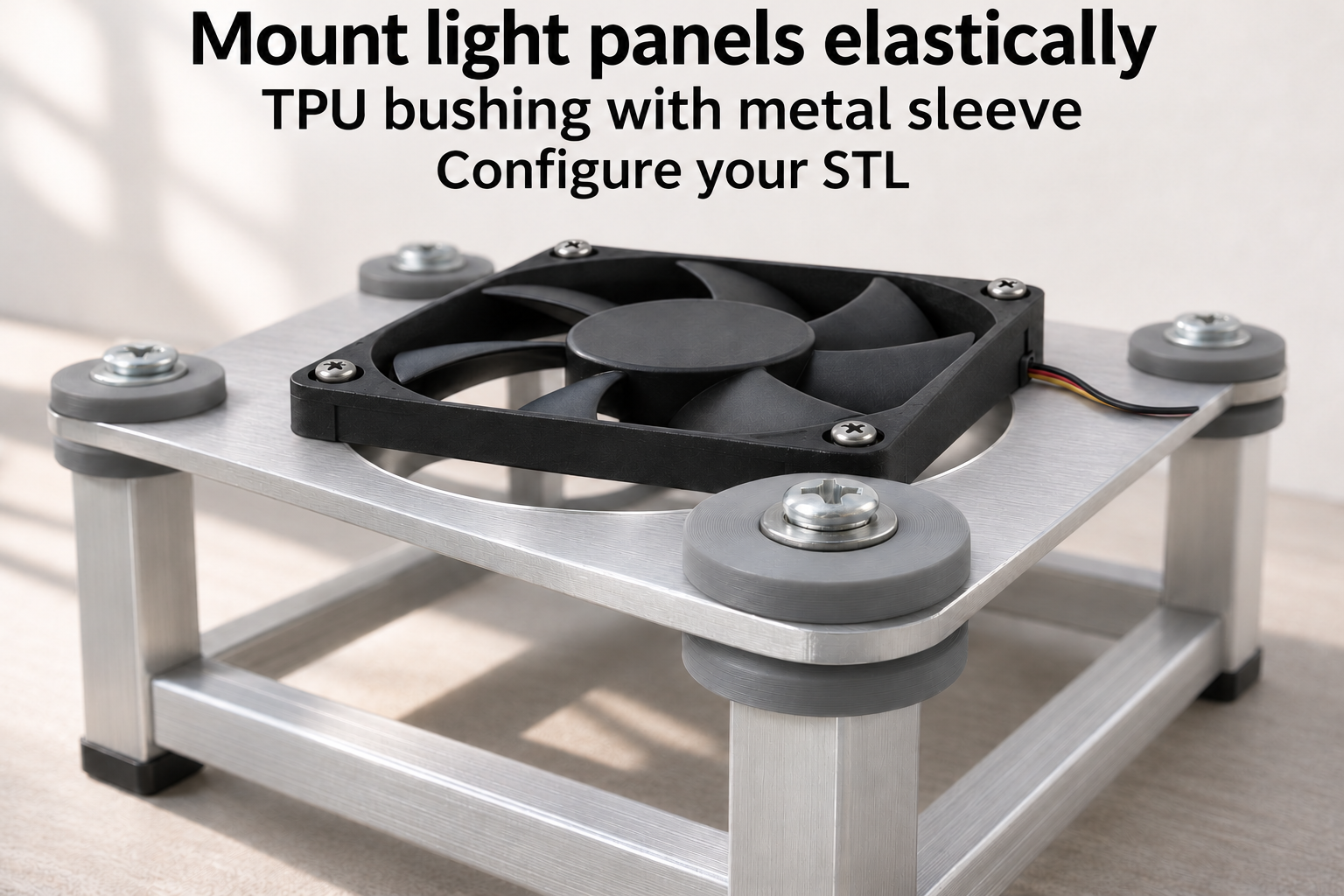
Support the panel through flexible flanges
A lightweight enclosure or fan panel can be mounted through flexible bushings in a supported hobby assembly. This one-piece shape has two outer flanges separated by an annular groove. The panel hole surrounds the narrower neck, with one flange above the panel and the other below.
A central bore takes your own metal sleeve, through which the fastening screw passes. Select sleeve and washers so tightening clamps the metal sleeve rather than simply flattening the TPU. Screws, washers and the surrounding support should not make a rigid contact bridge to the panel being held.
Distinguish hole size, groove and sleeve bore
Panel hole size ranges from 8 to 22 mm, starting at 12 mm. Installation clearance is 0.1–0.6 mm, initially 0.3 mm; it is subtracted from the hole size to define neck diameter. The starting neck is therefore 11.7 mm. This allowance is not automatically added to the sleeve bore.
Panel thickness ranges from 1 to 6 mm, starting at 3 mm. The groove is designed 0.2 mm taller. Flange diameter is 12–32 mm, initially 18 mm; the construction requires it to exceed the hole diameter by more than 3 mm. Upper and lower flange thickness each range from 1.5 to 5 mm, initially 2.5 and 2 mm.
Print in TPU and inspect the assembled fastening
The central sleeve bore ranges from 4 to 12 mm, initially 6.2 mm. Measure the sleeve outside diameter and determine its required length from the complete fastening stack. Enough flexible material must remain between neck and bore. Deburr the panel hole as well, so its edge cannot cut into the TPU.
Use flexible TPU and trial one mounting position first. After gently tightening, check that the panel is still supported only through the bushing and that neither flange has displaced. Damping and long-term durability have not been measured, so no specific noise reduction is assured. This is not a replacement for load-bearing motor mounts or protective components. Sleeves, washers, screws and panel are separate supplies.
The image is an AI application visualization, not a photograph of a physically tested print. Accessories shown are not included in the STL.
Next step