

Guitar and music ·
Try a guitar pick with your own width, length and thickness
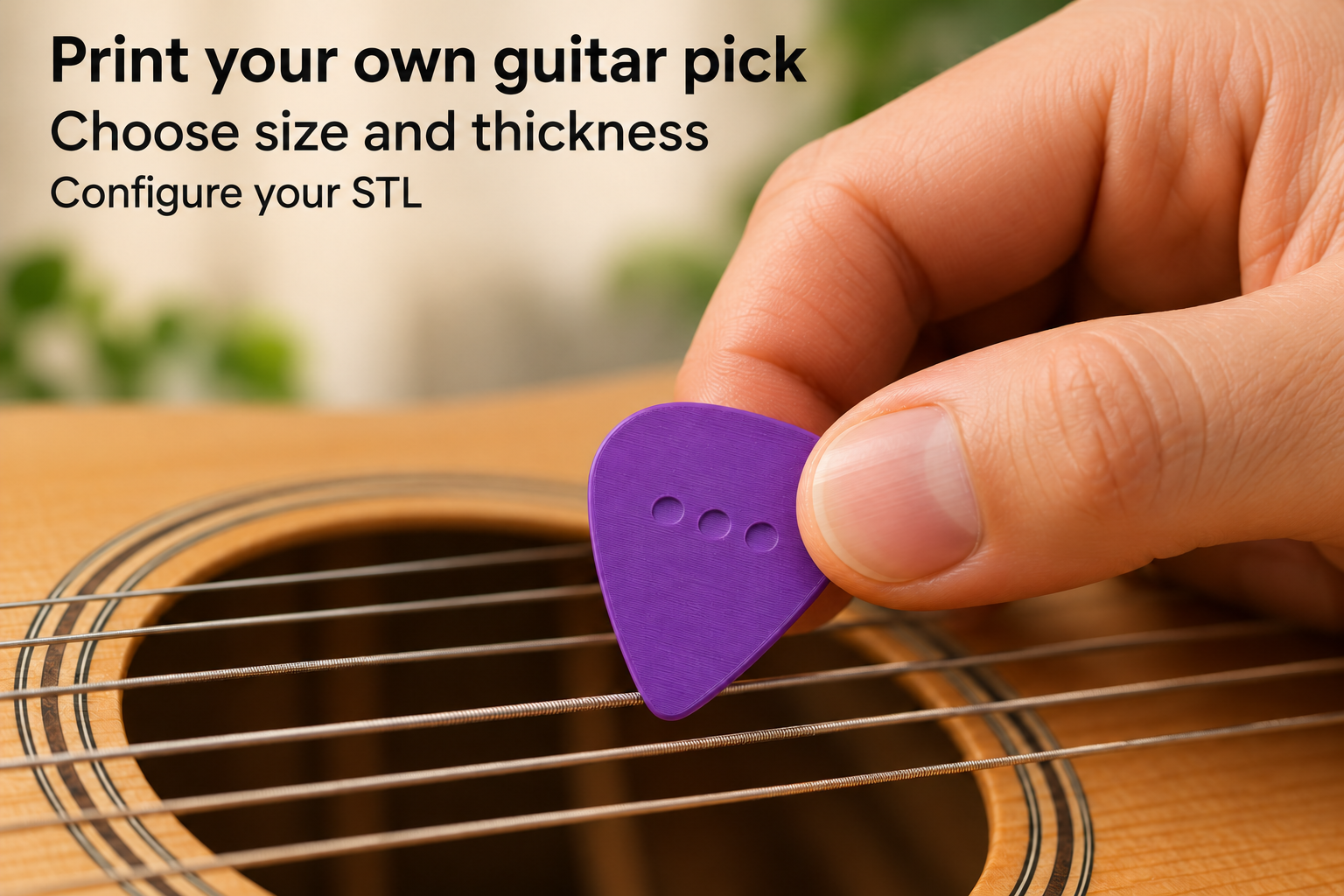
Configure a rounded triangular pick for your grip. Three shallow dimples mark one face; size, material and printing all contribute to how it feels.
Change the shape in manageable steps
A pick is easy to misplace, but replacing one is also a chance to compare how different sizes feel. This model provides a rounded triangular shape with a broad shoulder held between thumb and index finger and a rounded tip presented to the string. You can change its dimensions without changing that basic outline.
The STL contains one pick. Three small shallow grip dimples sit in a row on one face, while the back stays flat. These are recesses, not holes through the pick.
Choose width, length and thickness deliberately
Width ranges from 18 to 32 mm, length from 22 to 38 mm and base thickness from 0.6 to 2.6 mm. The initial dimensions are 24 × 28 × 1.2 mm. Each of the three dimples is 2.2 mm across and 0.2 mm deep.
Start by measuring a pick that already sits comfortably in your hand. Change one parameter at a time so you can compare the result. Greater thickness usually reduces flexibility in the same material, but filament and print orientation also matter. Dimensions alone cannot promise a particular tone or playing response.
Print flat, finish the edges and test gently
The suggested starting settings are PETG, 0.2 mm layers and four perimeters. Place the flat back on the build plate and inspect the sliced preview for a fully closed, solid thin part. For thinner versions, check the actual layer count and the material remaining beneath the grip dimples.
Smooth the rounded tip and perimeter carefully without creating a sharp cutting edge. Start with a light stroke and check that the tip passes cleanly over the string. Rough edges can catch. Compare grip and flex using the same playing motion before changing another setting. Inspect the pick regularly for notches, sharp wear or cracks, and replace a damaged part. A small set of clearly labelled dimensions makes comparisons more useful than printing many unrecorded variants.
The image is an AI application visualization, not a photograph of a physically tested print. Accessories shown are not included in the STL.
Next step