


Light indoor decoration ·
Hang a light wooden box with a custom keyhole hanger block
A screw-mounted block captures a wall-screw head behind a narrow slot. Match the entry, rear pocket and mounting holes to your lightweight decorative box.
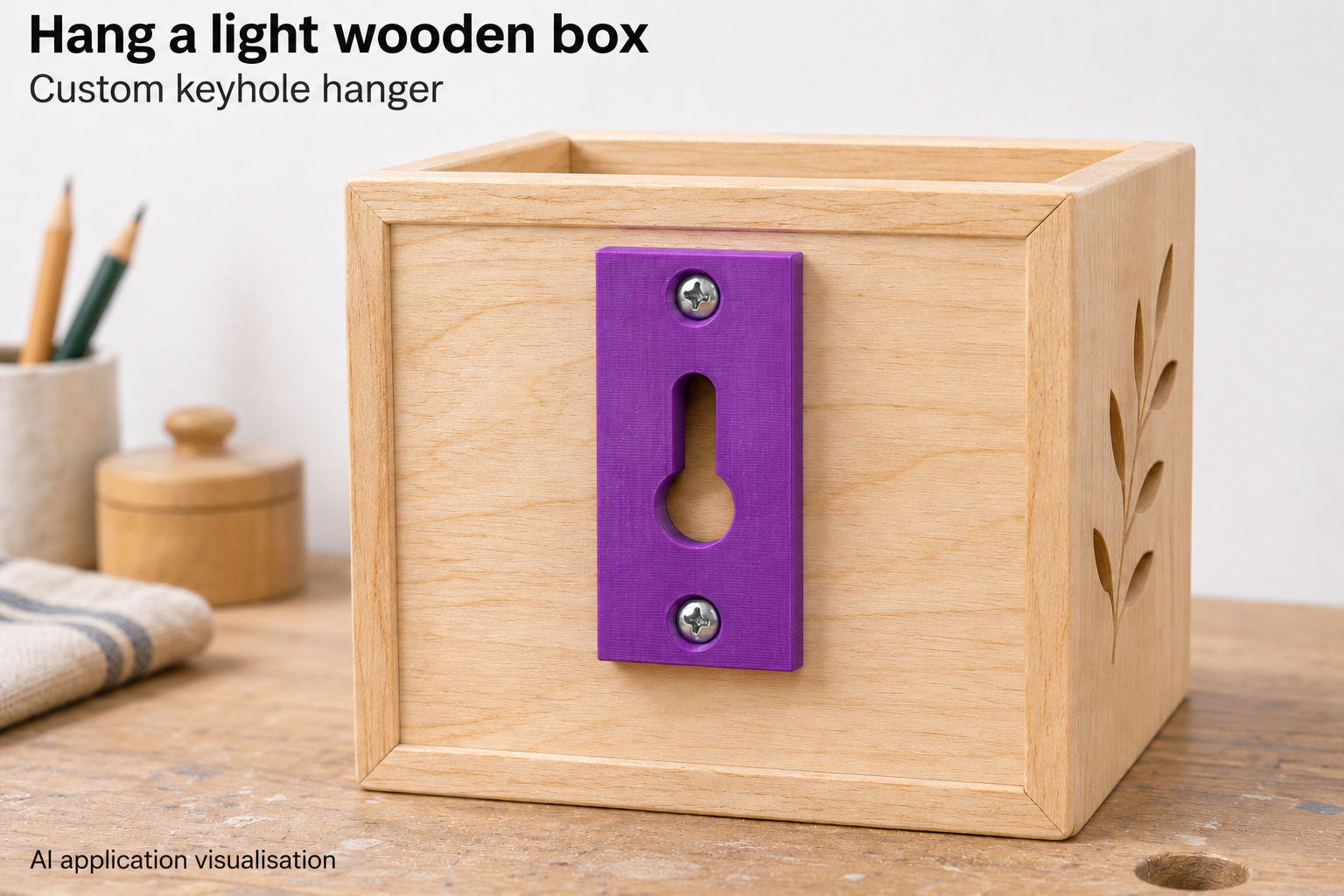
A concealed receiver for a wall screw
A small decorative box can hang from a screw without a visible hook projecting above its top edge. This hanger block screws to the back of the box. The wall-screw head enters through the large lower opening. Lowering the box moves the shank upward relative to the block, into the narrow upper slot, while the head stays captured behind the front face.
The head pocket is open at the rear. Your flat mounting surface closes it. Attach the block to a sufficiently firm, continuous surface rather than across a cut-out. The small holes at the top and bottom fasten the block to the box; they are separate from the central wall-screw receiver.
Measure the head and shank separately
Head entry adjusts from 6 to 14 mm and shank slot width from 3 to 7 mm. Measure the actual wall screw’s largest head diameter, head thickness and shank diameter. Include enough entry clearance, but ensure the real head remains substantially wider than the narrow slot so it cannot pull through.
The 9 mm entry and 4.5 mm slot defaults do not guarantee compatibility with a particular screw standard. The configurator requires more than 2 mm difference between these input dimensions. Actual retaining overlap also depends on the selected screw and printed dimensions.
Check head thickness as well as diameter
Overall depth adjusts from 4.5 to 10 mm and remaining front thickness from 2 to 4 mm. Their difference gives the nominal pocket depth: a 6 mm block with a 2.4 mm front leaves 3.6 mm for the screw head and movement clearance. A suitable head diameter alone is not enough.
Block width ranges from 18 to 42 mm and height from 36 to 75 mm. The 8–24 mm travel setting determines the centre-to-centre spacing between the lower entry and the upper slot’s rounded end in the model. Usable lowering movement also depends on shank diameter. Adequate block height keeps the pocket clear of the fixing holes.
Attach to the box and try the hanging movement
Print on the front face and remove debris from the pocket and openings. Fixing holes adjust from 2.5 to 5 mm. Their head recesses are 1.2 mm deep and 2 mm larger in diameter than the fixing hole. Choose fixing heads that fit those recesses and a screw length that holds in the box wall without piercing its inside.
Orient the large entry downward and screw both ends onto the flat box surface. Choose the wall fixing for the actual substrate. Its projection must permit insertion and lowering without excessive looseness. Raised rear frames or other parts of the box must not prevent the hanger from reaching the wall screw. Try the movement with the empty box close above a supporting surface.
Light decoration without a load rating
This model is intended only for light indoor decoration. It has no specified load rating or anti-lift lock: lifting can release the connection. A single central hanging point does not prevent every rotational movement of the box. Plan the fixing arrangement for your object rather than inferring capacity from the image.
The image is an AI application visualisation showing the block attached to the box before hanging. No physical test prints have been made. After checking dimensions and fit, configure the STL for your own printer or use the available manufacturing option.
Next step