


Music and instrument care ·
Rest a guitar neck on a custom padded support during light care
Match a shallow cradle, support height and base depth to your guitar and separate soft padding, with the body resting on a padded surface too.
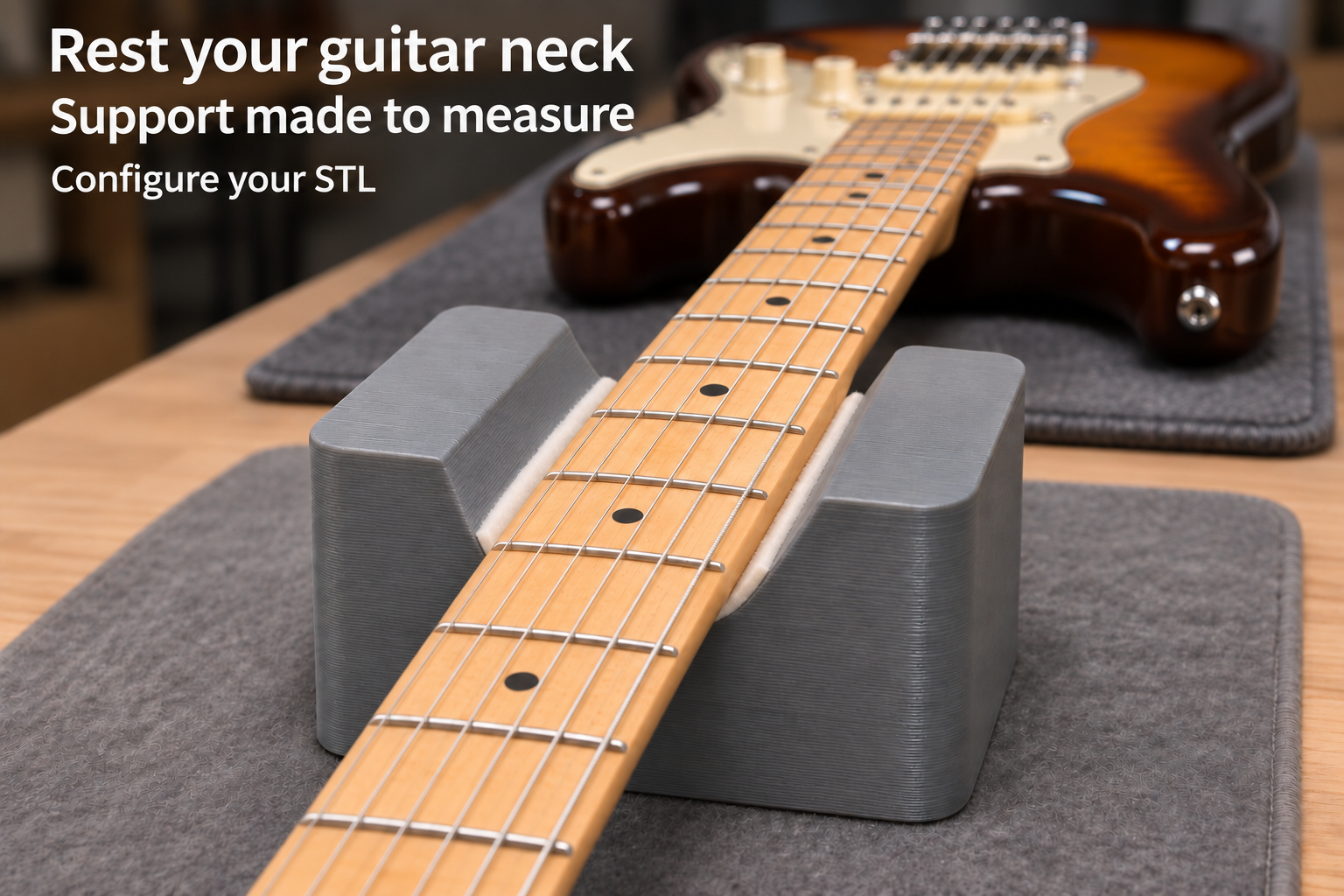
Support a resting guitar during gentle care
When gently wiping or inspecting a guitar laid on a table, its neck needs suitable support. This model provides a broad block with a shallow circular trough on its upper face. The neck runs along that trough while the body rests on a separate flat, padded surface.
It is a stationary resting support for light care, not a wall hanger or a clamping fixture. Clamping, hammering and heavy repair work are outside its intended use. Arrange the entire instrument so it rests without sideways pressure or rocking.
Choose the radius and height with the padding in mind
Unpadded cradle radius adjusts from 25 to 50 mm. The lowest point of the unpadded trough can be set from 25 to 75 mm above the table, and base depth along the neck from 30 to 60 mm. The starting values are 35 mm radius, 45 mm lowest height and 45 mm depth.
The height setting is not the total block height: the upper shoulders are 12 mm higher. At the starting values, the block is therefore 57 mm tall and 90 mm wide. Check the neck profile at the intended contact point and the height of the already padded body. Adding a liner changes both the usable cradle shape and the actual support height.
Protect the contact surfaces and check the whole arrangement
Before use, add separate soft, clean padding inside the trough. Its material must be compatible with your instrument’s finish; an arbitrary foam or rubber is not automatically suitable. Keep contact areas free of grit and use an appropriate pad beneath the body as well.
The model suggests PETG, 0.2 mm layers and at least four perimeters as a printing starting point, with the flat base on the bed. Inspect the finished block for warping and sharp edges. Lower the guitar with both hands and check the support beneath its body and neck. Do not balance the whole instrument on the neck block alone. The padding and guitar are separate items, and this printed support does not establish suitability for forceful repair work.
The image is an AI application visualization, not a photograph of a physically tested print. Accessories shown are not included in the STL.
Next step