


3D printing and filament guides ·
Rest a small filament spool on two bearing-supported rollers
The spool flange rims run on two parallel rollers while the centre hole stays unused. Width, axle spacing and base clearance must suit the actual spool.
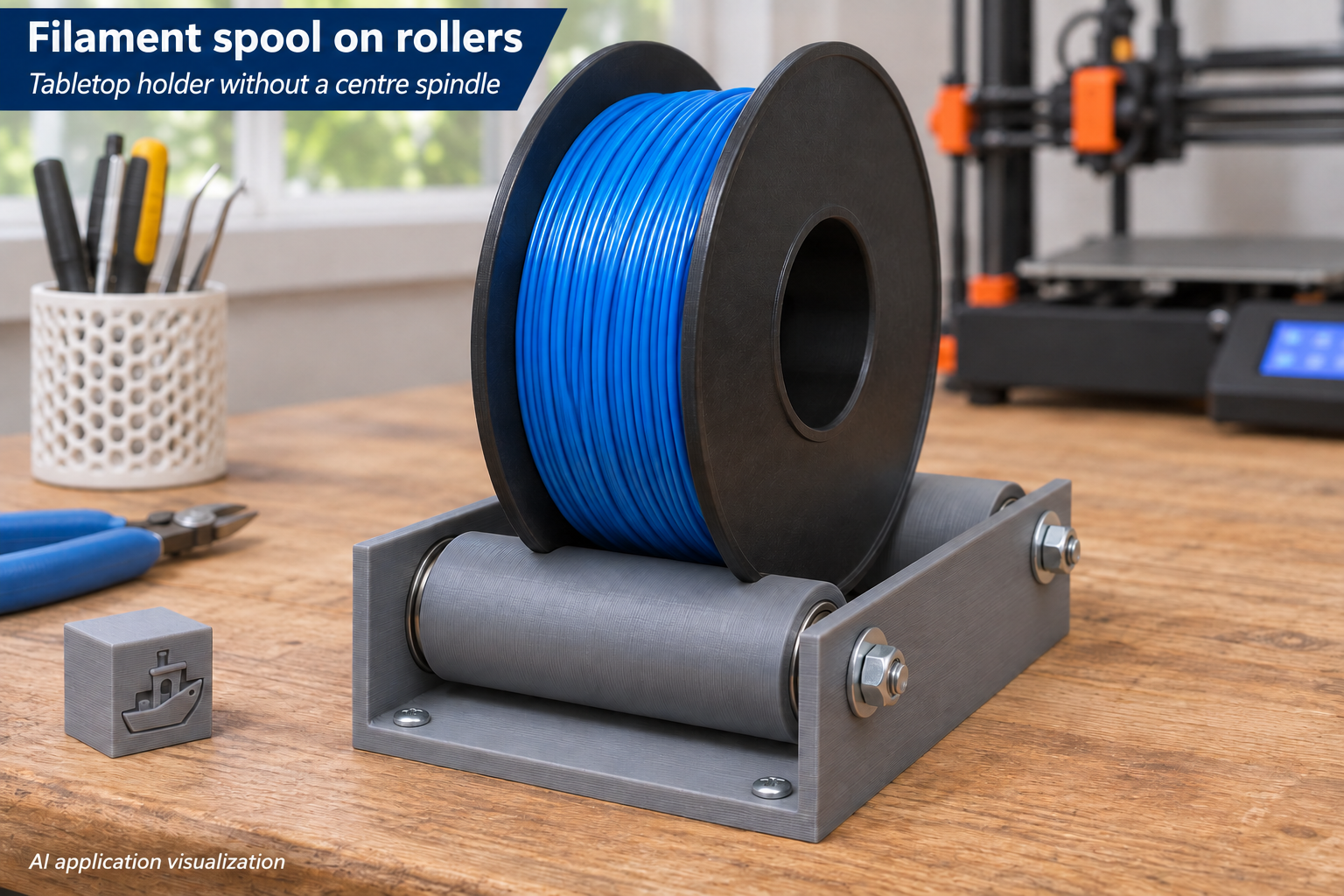
Carry the spool at its rims
A small lightweight filament spool can rest on two parallel rollers when a suitable central mount is unavailable. Each of its two flange rims contacts both rollers. The spool axis runs parallel to the roller axes, leaving the central hole unused.
The model contains a base with two side cheeks and two separately printed rollers. Supply four ball bearings, two continuous metal axles, suitable washers and locking nuts separately. No load capacity is specified.
Check spool width and bottom clearance
Roller length adjusts from 30 to 110 mm, initially 70 mm. Overall spool width must be smaller so both rims remain supported without rubbing the cheeks. Roller diameter is 24–48 mm, with 32 mm as the default.
Axle spacing is 40–110 mm, initially 70 mm. It must exceed roller diameter plus 6 mm. For this geometry, choose flange diameters larger than the axle spacing and also check that the spool’s lowest point clears the base. Damaged or uneven rims make smooth rolling difficult.
Match bearing pockets and axles
The bearing outside-diameter setting of 16–32 mm defines the printed pocket size, including print allowance; its default is 22.2 mm. Pocket depth is 4–10 mm, initially 7.2 mm. Each roller has a bearing pocket at both ends.
The shared axle passage adjusts from 4.5 to 12 mm, initially 8.4 mm. Match bearing bore, metal axle and passage together. Roller diameter must exceed pocket diameter by more than 4 mm, and the two pockets must not meet inside the roller. Make a trial print if the fit is uncertain.
Assemble and check free rotation
Fit the bearings and install both rollers horizontally between the cheeks. The axles pass through the cheeks and bearing inner rings. Secure them without washers or nuts rubbing the rotating printed bodies. Four fixed 3.4 mm holes fasten the base to a flat tabletop.
Cheek thickness adjusts from 2.4 to 5 mm and base thickness from 3 to 6 mm. Check movement first without a spool, then with the small lightweight spool, including clearance underneath. This is not a universal heavy-duty reel stand. The picture is an AI application visualization; no physical test prints have been performed.
Next step