

3D model platforms compared ·
Thingiverse, Printables or Cults3D? The best platform for functional 3D models
Thingiverse, Printables and Cults3D offer a large selection of ready-made STL files. For functional parts with individual dimensions, however, fixed downloads are often unsuitable. MachDeinTeil makes it possible to configure parametric 3D models directly to your own measurements.
🔍 Fixed STL file or functional 3D model made to measure?
Thingiverse, Printables and Cults3D are among the best-known platforms for 3D printing models. They offer a huge selection of ready-made STL files for decorations, toys, spare parts and technical applications.
For functional parts, however, there is a fundamental problem: an STL file has fixed dimensions. If the required diameter, hole spacing or desired length differs even slightly, the model will not fit.
MachDeinTeil therefore follows a different approach. Instead of providing only fixed STL files, functional models can be parameterized directly in the browser and adapted to your own measurements.
Thingiverse: a huge selection of free STL files
Thingiverse is one of the best-known and oldest platforms for 3D printing models. Its community has published a very large number of free models. From simple decorations and household items to technical components, almost every category is represented.
Advantages of Thingiverse
- Very large selection of 3D models
- Many files can be downloaded for free
- Large and long-established active community
- Many remixes and variants of existing models
Disadvantages of Thingiverse
- Many older or no longer maintained models
- Highly inconsistent quality standards
- Search can be confusing for specific technical requirements
- Models are mainly offered as fixed STL files
- Custom dimensions must be adjusted afterwards in CAD software
Thingiverse is especially useful when a model with the right dimensions already exists. For brackets, adapters or spare parts, however, the process often starts with a long search for a variant that happens to fit exactly.
Printables: a modern platform with an active community
Printables has established itself as a modern alternative to Thingiverse. The platform offers a clear user interface, detailed model pages and an active community. Many models are well documented and have already been printed successfully by other users.
Advantages of Printables
- Clear and modern platform
- Many high-quality and well-documented models
- Active community with ratings and print results
- Good selection of functional projects
Disadvantages of Printables
- Most models have fixed dimensions
- Specific measurements are often not available
- Adjustments require CAD skills or a suitable source file
- Even high-quality models do not automatically fit your own use case
Printables is a good choice for makers looking for high-quality and tested models. However, the basic problem of a finished STL file remains: the model can only be used directly if its dimensions already match your application.
Cults3D: free and paid premium models
Cults3D combines a large model library with a marketplace for paid designs. In addition to free files, users can find many elaborately designed models, special parts and professional constructions.
Advantages of Cults3D
- Large selection of free and paid models
- Many professional designers
- High-quality premium files
- Wide range of creative and technical models
Disadvantages of Cults3D
- Many interesting models are paid
- A purchased STL file still has fixed dimensions
- Custom variants are not always included in the purchase price
- Changes often require CAD skills
Cults3D is especially suitable for users who are looking for a high-quality design and are willing to pay for a professional file. For dimension-dependent spare parts or adapters, however, there is still a risk that the model will not fit exactly despite its good quality.
The problem with classic STL platforms
Thingiverse, Printables and Cults3D differ in terms of user interface, community, quality and business model. For functional models, however, they have one central thing in common: in most cases, a finished file with fixed dimensions is downloaded.
This works very well when the existing design matches the intended use exactly. In practice, however, even small deviations are enough to make a functional part unusable.
- The inner diameter of an adapter is 2 mm too small.
- The hole spacing of a mounting plate is incorrect.
- A bracket is a few millimeters too short.
- The wall thickness is unsuitable for the desired load.
- A screw hole has the wrong diameter.
- A pipe connector does not fit the existing connections.
In these cases, you either have to keep searching for a suitable file or modify the model in CAD software. That takes time and requires the necessary skills.
Parametric models instead of fixed downloads
A parametric model is not designed in just one fixed size. Instead, it has editable values known as parameters. These can include length, width, height, diameter, wall thickness, hole spacing or the number of certain elements, for example.
The user enters the required measurements. The geometry of the model is then recalculated based on these values. This creates not just a scaled copy, but a functional model whose design adapts specifically to the inputs.
This is especially important because simply scaling an STL file is often not enough. For example, if an adapter is enlarged as a whole, wall thicknesses, holes and all other dimensions change at the same time. In a parametric model, however, inner and outer diameters can be defined independently of each other.
MachDeinTeil: functional 3D models made to measure
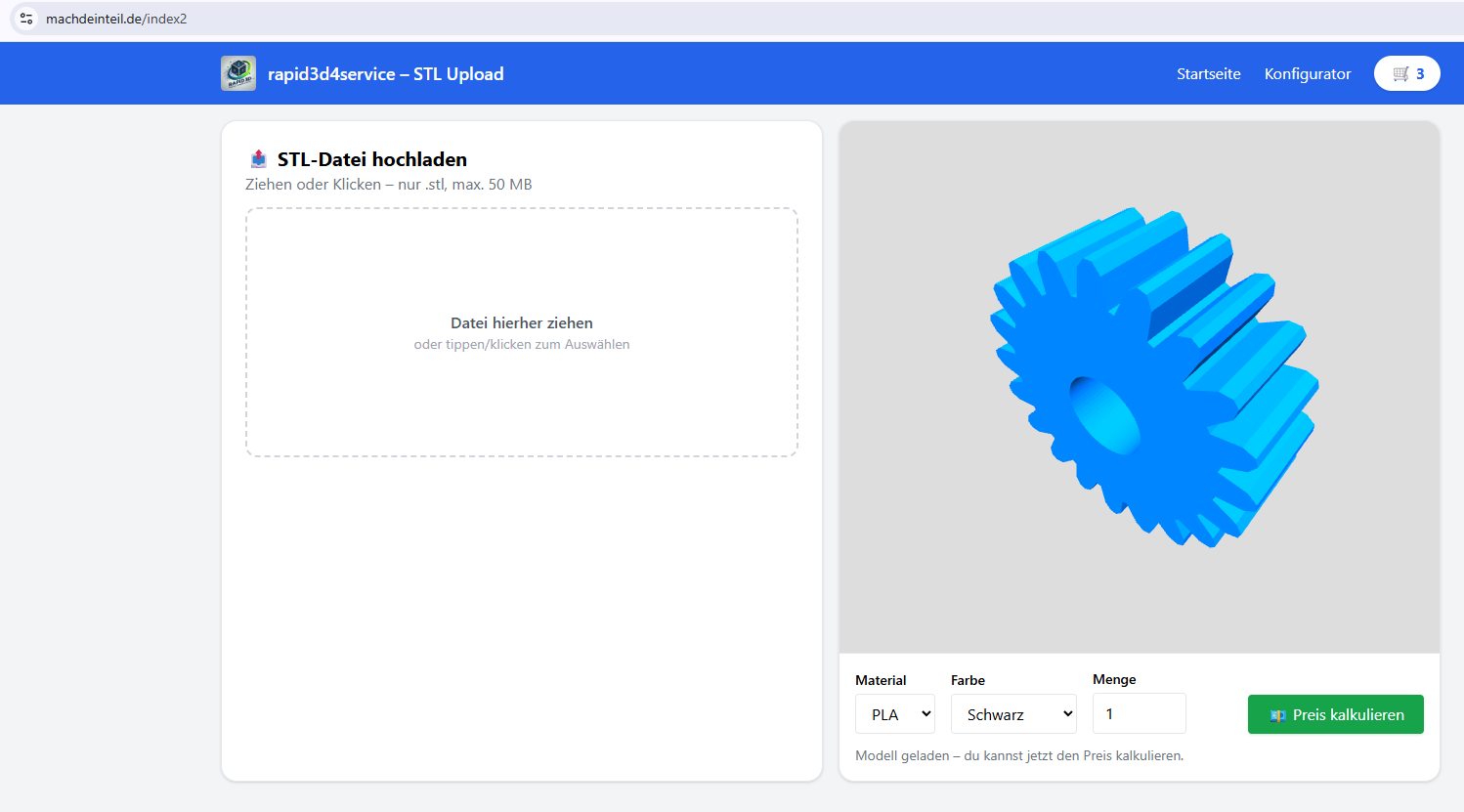
MachDeinTeil relies on parametric CAD configurators instead of only offering finished STL files. Users select a suitable base model and then enter their individual dimensions directly in the browser.
Depending on the model, diameters, length, width, wall thickness, holes, hole spacing or other design properties can be adjusted. The 3D preview updates based on the entered values.
- Select a suitable functional base model.
- Enter your own dimensions and required parameters.
- Check the customized model in the 3D preview.
- Download the generated file or have the part manufactured directly.
This eliminates the need to search for an STL file that happens to have been published in the correct size.
For which models is parameterization especially useful?
Not every 3D model needs to be individually configurable. For figures, decorations or art objects, ready-made files are often sufficient. The advantage of parametric models is especially strong for parts whose function directly depends on their dimensions.
- Adapters between different connections
- Pipe connectors and reducers
- Brackets for devices or tools
- Mounting plates with custom holes
- Flanges and covers
- Housings and boxes
- Gears
- Spare parts for older devices
- Technical custom solutions
In these applications, fit determines whether the printed part can actually be used.
Practical example: an adapter for two different diameters
Suppose a hose with a certain diameter needs to be connected to a fitting with another diameter.
On a classic STL platform, you have to search for exactly this combination. If one of the diameters, the length or the wall thickness does not match, the model cannot be used directly.
With a parametric adapter, the first diameter, the second diameter, the length and, if necessary, the wall thickness are entered. The model is then generated based on these values. This creates an adapter for the specific use case instead of a generic download with fixed dimensions.
The advantages of parametric models at a glance
- ✅ Your own measurements instead of fixed dimensions
- ✅ No long search for an STL file that happens to fit
- ✅ Functional adjustment instead of inaccurate scaling
- ✅ Live 3D preview before download or order
- ✅ No traditional CAD software required
- ✅ Fewer failed prints and lower material consumption
- ✅ Suitable for adapters, brackets, spare parts and custom solutions
- ✅ Download the file or have it manufactured directly
Which platform is best for functional 3D models?
The best platform depends on the specific use case.
Thingiverse is suitable for users looking for the largest possible selection of free community models.
Printables is a good choice for high-quality, well-documented models and a modern user experience.
Cults3D is useful when professional or paid premium designs are needed.
MachDeinTeil is especially interesting when a functional part should not merely be similar, but should be created to fit specific measurements.
MachDeinTeil therefore does not completely replace the classic platforms. It complements them with an approach that is often better suited to technical and dimension-dependent parts: configure instead of search.
FAQ
What is the most important difference between MachDeinTeil and classic STL platforms?
On classic platforms, users mainly download finished files with fixed dimensions. With MachDeinTeil, selected models can be adapted to individual measurements through parameters and then generated anew.
Can I not simply scale an STL file?
Scaling normally changes all dimensions at the same time. This also makes holes, wall thicknesses and other details larger or smaller. With a parametric model, relevant dimensions can be defined independently of each other.
Do I need CAD skills?
No. Adjustments are made through input fields for the available dimensions and parameters. The model is generated automatically based on this information.
Which parts is MachDeinTeil especially suitable for?
The parametric approach is especially suitable for adapters, brackets, pipe connectors, mounting plates, housings, gears, spare parts and other functional components.
Can I print the configured model myself?
Yes. After configuration, the generated model can be downloaded and manufactured with your own 3D printer or by an external service provider.
Does that mean Thingiverse, Printables or Cults3D are unsuitable?
No. All three platforms offer a large selection of interesting models. For functional parts with individual dimensions, however, a parametric configurator can be more efficient than searching for a suitable finished file.
Configure a functional 3D model made to measure
Select a suitable base model, enter your measurements and check the result directly in the 3D preview instead of searching through numerous fixed STL files for the right size.
Nächster Schritt