


Adapters & connections STL guides ·
Ferrite toroid mounting cradle STL: Create a Custom-Size 3D Model
Create a custom-size ferrite toroid mounting cradle STL for your own 3D printer. Check the model controls, measure the fit and buy the generated digital file.
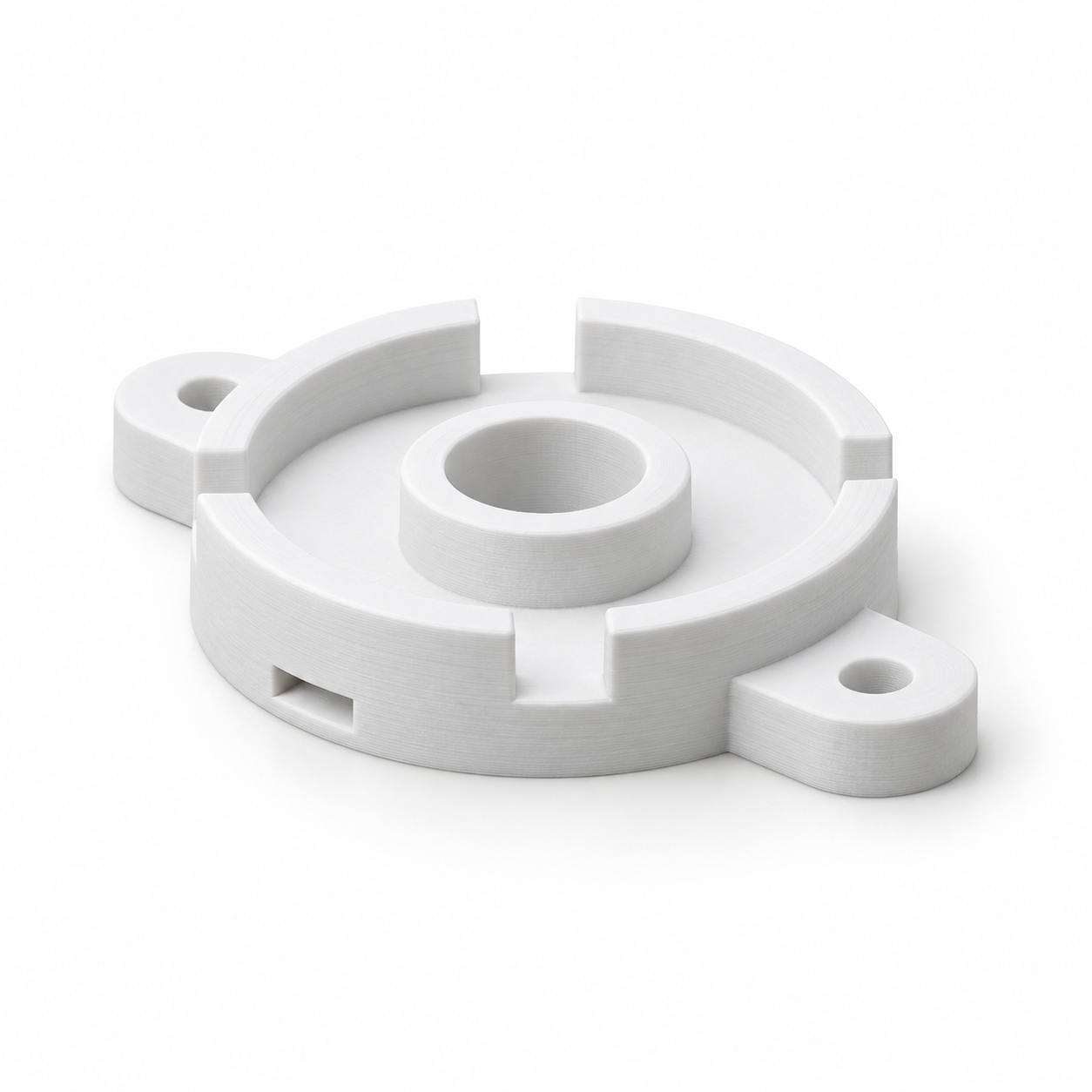
An annular seat with a low inner boss and interrupted outer rim locates the toroid. Two radial tunnels beneath the seat route your narrow plastic straps from the centre opening outward to hold the ring gently. Two screw ears attach the cradle, and rim openings leave space for winding leads. Measure the fully wound toroid and include room for soft lining. Do not overtighten straps or stress brittle ferrite. For small passive toroids in extra-low-voltage hobby assemblies; not a mains transformer mount, and without insulation, fire or EMC certification. Toroid, straps and screws are separate. Have your own 3D printer?
With the Ferrite toroid mounting cradle with two strap tunnels template, you can turn those measurements into a custom-size STL. Review controls such as wound toroid outside diameter, free toroid inside diameter, wound toroid height, check your model in the preview and choose the digital file. You buy the generated STL and print it on your own 3D printer, using your preferred filament and slicer settings.
Measurements for your ferrite toroid mounting cradle STL
The product page exposes the following useful geometry controls. Work from your measured parts and check the displayed units and the preview before entering final values.
| Model control | What to check |
|---|---|
| Wound toroid outside diameter | Measure the external mating surface; compare it with the receiving opening. |
| Free toroid inside diameter | Measure the object or opening that this internal space must accommodate. |
| Wound toroid height | Measure from the relevant seating surface and check the available vertical clearance. |
| Rim and boss thickness | Measure between the two relevant faces and check fit in any receiving slot. |
| Seat thickness | Measure between the two relevant faces and check fit in any receiving slot. |
| Strap tunnel width | Measure across the named feature and allow space for the neighbouring parts. |
| Strap tunnel height | Measure from the relevant seating surface and check the available vertical clearance. |
| Mounting hole | Check this feature against the matching component and confirm its effect in the 3D preview. |
Separate the object fit from the mounting interface
Write down the size of the object being supported and the measurements of the mounting surface as two separate groups. Check access for insertion, removal and any fasteners in the preview. Hole diameter, hole spacing and clearance behind the part solve different problems.
Configure the model, buy the STL and print locally
- Open the ferrite toroid mounting cradle product page and compare the model preview with your application.
- Enter the relevant measurements. Use the units displayed beside each input; convert inch measurements before using a millimetre field.
- Review the complete geometry and keep a record of your parameter values. Check small openings, mating features and remaining wall thickness.
- Choose the digital STL purchase option and review the current price and order details before payment.
- After receiving the STL, open it in your slicer, confirm the imported dimensions and inspect the layer preview before printing.
Configure my ferrite toroid mounting cradle STL
Check a first print before making more
A CAD dimension and a printed dimension can differ. Print a fit sample or one prototype before making a batch, and check the features that contact other parts. Choose print orientation, supports and material for the actual geometry and application. There is no universal clearance or print profile that guarantees the fit on every machine.
Before you choose your STL
Why configure the model instead of scaling a download?
Uniform scaling changes all dimensions together. Here you can work with the available controls, including wound toroid outside diameter, free toroid inside diameter, wound toroid height, and check the result before purchase. Keep your input values for later revisions: the downloaded STL contains the final mesh, rather than the original parametric editing history.
What do I buy?
Select the digital STL option for the file you will print yourself. Review the current price and selected configuration before paying. Ordering a finished print is a separate option.
Make the next print fit your project
Have your measurements ready? Open the ferrite toroid mounting cradle template, adjust the model and inspect the preview. When the geometry matches what you need, choose your STL and take it to your own printer.
Next step