


Plumbing ·
Faucet Thread Too Short? Create an 80 mm G 1/2 Extension for a Thick Countertop
Real-world use case: a G 1/2 faucet thread was shorter than the thick garden sink countertop. A custom plumbing adapter added approximately 80 mm of extra reach.
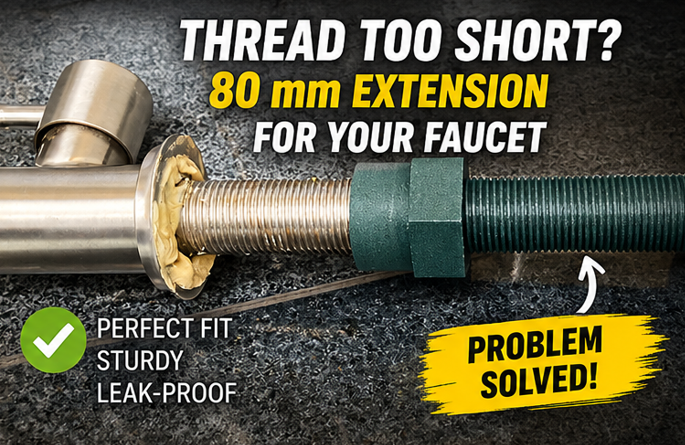
Faucet thread too short for a thick countertop? Configure a custom G 1/2 extension
For a garden sink installation, the threaded shank of the faucet was shorter than the countertop thickness. Once the faucet was inserted through the worktop, there was not enough usable thread left underneath to attach the fitting, locking hardware, or water connection securely.
The practical solution was a custom G 1/2 thread extension. Using the universal plumbing thread adapter configurator, a one-piece adapter could be created with a matching female thread on one side, a male thread on the other, and approximately 80 mm of additional length. This made it possible to mount the faucet even though the original threaded pipe section was too short for the garden sink countertop.
The real problem: the faucet thread does not reach through the countertop
Most faucets are designed for relatively thin sinks or standard countertops. When the mounting surface is made from thick timber, stone, concrete, composite board, or a custom outdoor worktop, the threaded faucet shank may disappear almost completely inside the material.
This creates several common installation problems:
- The retaining nut only catches one or two threads.
- The water hose cannot be connected underneath the sink.
- The threaded end stops inside the countertop.
- The faucet cannot be tightened securely.
- A standard extension is too short or uses the wrong thread.
- The available adapter has the wrong male or female configuration.
The use case: a garden sink with an unusually thick worktop
In this project, a faucet needed to be installed in a garden sink. The countertop was much thicker than the sheet metal around a typical kitchen sink. The faucet's pipe thread was therefore too short to reach far enough below the worktop.
The missing length was approximately 80 mm. The actual search intent behind the problem was not “parametric adapter.” It was much more practical:
- faucet thread too short
- countertop too thick for faucet
- G 1/2 thread extension 80 mm
- extend faucet threaded shank
- custom plumbing thread adapter
- install faucet through thick wood countertop
The solution: a configurable plumbing thread adapter
The universal plumbing thread adapter can connect two independently configured threaded ends in a single part. Each side can be set as a male or female thread, and the thread sizes and engagement lengths can be selected separately.
For a typical extension of an existing male G 1/2 faucet thread, the basic configuration is:
- Side A: G 1/2 female thread to screw onto the faucet
- Side B: G 1/2 male thread as the new extended connection
- Center body: long enough to bridge the countertop and provide the required extra reach
Other combinations are possible, including female-to-female couplers, male-to-male nipples, metric-to-BSPP transitions, reducers, and custom-length plumbing adapters.
➡ Open the universal thread adapter configurator
Why G 1/2 does not mean a 1/2-inch outside diameter
G threads are parallel pipe threads commonly associated with BSPP. The nominal size does not equal the measured outside diameter. A thread measuring around 21 mm across the outside may still be identified as G 1/2, depending on its pitch and profile.
Before configuring an adapter, check:
- the actual outside or inside diameter
- the thread pitch or threads per inch
- whether the thread is parallel or tapered
- whether the faucet end is male or female
- the available usable thread length
- the sealing method used by the connection
Many parallel G/BSPP connections do not seal solely through the thread flanks. Depending on the fitting, sealing may be provided by a washer, O-ring, gasket, or dedicated sealing face. Mechanical fit and sealing compatibility must therefore both be checked.
How to calculate the required extension length
The extension should be based on a simple measurement chain rather than guesswork:
- Measure the total countertop thickness.
- Measure the usable threaded length of the faucet.
- Determine how much thread is required underneath for the fitting or hose.
- Allow room for the retaining nut, gasket, washer, and tools.
- Calculate the missing length.
A simplified formula is:
Required extension = countertop thickness + required connection length − usable faucet thread length
In this project, the result was approximately 80 mm. This non-standard length is exactly where a parametric model becomes useful, because it is not limited to typical stock sizes such as 10, 20, 30, or 50 mm.
Example configuration for an 80 mm G 1/2 faucet extension
| Parameter | Example | Purpose |
|---|---|---|
| Side A thread size | G 1/2 | Matches the existing faucet thread. |
| Side A thread type | Female | Screws onto the faucet's male thread. |
| Side A thread length | According to the usable faucet thread | Provides sufficient engagement without bottoming out. |
| Side B thread size | G 1/2 | Continues the same nominal connection size. |
| Side B thread type | Male | Creates the new connection below the countertop. |
| Side B thread length | According to the mating hose or fitting | Ensures enough usable thread for the final connection. |
| Hex body length | Set to achieve about 80 mm of additional reach | Bridges the thick worktop and provides a wrenching surface. |
This table describes the principle used in the project. The exact thread engagement and overall body length must be verified against the real faucet, countertop, gasket, nut, and downstream fitting.
Why female-to-male is the logical configuration
If the faucet has a G 1/2 male thread, the extension needs a matching G 1/2 female thread on the faucet side. To continue the same connection below the worktop, the opposite side can be configured as a G 1/2 male thread.
This creates a direct extension without changing the nominal pipe size. The configurator can also be used for:
- female-to-female long couplers
- male-to-male threaded nipples
- metric-to-G/BSPP adapters
- G/BSPP-to-metric transitions
- reducers between different thread sizes
- different thread lengths on both ends
Why a hexagonal center body helps during assembly
A long round adapter can be difficult to hold under a countertop. A hexagonal center section provides a practical wrenching surface. This allows the adapter to be held while tightening the faucet connection, retaining hardware, or hose fitting.
The longer the adapter, the greater the leverage created at the end of the part. A 3D-printed thread should not be tightened with the same torque as a solid metal plumbing fitting. Excessive force can strip the threads, split the body, or damage the printed layer structure.
Real search intent for this problem
Problem-aware searches
- faucet thread too short
- tap thread too short for countertop
- countertop too thick for faucet
- faucet shank does not reach through worktop
- faucet cannot be tightened under sink
- thread under sink too short
- install faucet in thick wood countertop
- garden sink faucet mounting problem
Solution-aware searches
- G 1/2 thread extension
- G 1/2 female to male extension
- BSPP thread extension
- faucet threaded shank extension
- tap thread extension
- plumbing thread extension 80 mm
- custom thread adapter
- extend faucet connection through countertop
Transactional searches
- custom G 1/2 adapter online
- configure BSPP thread adapter
- custom plumbing adapter STL
- 3D print G 1/2 extension
- order custom faucet thread extension
- generate threaded adapter STL
Typical applications
- Garden sink with a thick timber countertop
- Outdoor kitchen with a stone or concrete worktop
- Custom bathroom vanity
- Workshop sink installation
- Camper or motorhome kitchen
- DIY sink cabinet
- Rain barrel or garden water connection
- Prototype plumbing setup
- Test rig or temporary technical installation
- Custom furniture with a recessed faucet connection
Other thread sizes and adapter tasks
The configurator is not limited to G 1/2. Depending on the available options, it can be used for common parallel pipe threads and metric faucet or plumbing threads. Possible projects include:
- G 3/8 adapters for smaller plumbing connections
- G 1/2 faucet and water line adapters
- G 3/4 hose and garden water adapters
- metric faucet thread adapters
- metric-to-BSPP transitions
- custom reducers
- long female couplers
- male-to-male connecting nipples
3D printing: prototype, installation aid, or functional part?
A 3D-printed threaded adapter can be used as a dimensional prototype, installation aid, test part, or functional component depending on the material and application. It is not automatically pressure-rated, watertight, hot-water resistant, or approved for potable water.
Before any long-term use, evaluate:
- operating pressure and pressure spikes
- water temperature
- UV exposure and frost
- filament compatibility with the medium
- layer adhesion and print orientation
- the sealing concept
- mechanical loads from operating the faucet
- long-term creep of the plastic
- local regulations for potable water installations
For permanently pressurized or safety-critical plumbing, use an appropriately engineered and tested solution. The model can still be valuable for checking dimensions, fit, and installation space before commissioning a final part.
Material selection
PLA
PLA is easy to print and useful for fit checks, dry prototypes, and initial assembly tests. Standard PLA is generally not the first choice for long-term outdoor use, elevated temperature, or sustained mechanical loading.
PETG
PETG is tougher and often chosen for more durable functional prints. It may be more suitable for humid environments, but this does not automatically make a printed part watertight or approved for drinking water.
ASA
ASA offers improved UV and weather resistance compared with many standard filaments. This can be useful for an outdoor garden sink, although print quality, sealing, and mechanical strength still need to be verified.
Engineering filaments
Nylon, polycarbonate, and reinforced materials may provide improved mechanical performance but require appropriate printing conditions. Thread accuracy, toughness, and dimensional stability are especially important.
Print orientation and thread quality
The layer direction affects both thread finish and mechanical strength. Printing along the thread axis may produce clean thread geometry, but a long 80 mm adapter also creates a tall print. Printing horizontally may require support inside or around the threads.
A short test thread is strongly recommended before printing the full adapter. It can reveal issues with clearance, shrinkage, over-extrusion, and actual engagement with the faucet.
Installation guidance
- Clean the faucet thread and inspect it for damage.
- Test the adapter by hand before applying any sealing material.
- Do not cross-thread or force the connection.
- Check the required washer, gasket, O-ring, or sealing face.
- Tighten only moderately using an appropriate tool.
- Support the faucet against twisting and side loading.
- Align the connection below the countertop without stress.
- Perform a controlled leak test after assembly.
- Inspect the part regularly for cracks, loosening, or leakage.
Why the extension should not be the only structural faucet support
A faucet creates significant leverage when it is opened, closed, or moved sideways. A long thread extension should not automatically be treated as the only structural support. A wide washer, backing plate, retaining bracket, or separate mechanical support may be needed.
This is especially important with an 80 mm extension because the longer lever arm increases the load on the adapter and the original faucet thread.
Benefits of the configurable thread adapter
- ✅ Metric and G/BSPP thread options
- ✅ Male and female ends configurable independently
- ✅ Separate thread engagement lengths
- ✅ Unusual lengths such as approximately 80 mm
- ✅ One-piece adapter body
- ✅ Hex section for holding with a wrench
- ✅ Useful for prototypes and special connections
- ✅ Parametric STL generation
- ✅ Alternative when standard fittings do not match
FAQ: G 1/2 faucet thread extension for thick countertops
What can I do if my faucet thread is too short?
First check whether the faucet manufacturer offers an approved shank extension. If no suitable standard part exists, a custom adapter can be configured with the required female thread, body length, and new male thread.
Why is the faucet thread too short for my countertop?
Many faucets are designed for thin sink decks. A thick wood, stone, concrete, or composite worktop consumes most of the available threaded length.
Can a G 1/2 thread be extended by 80 mm?
A parametric adapter can represent this geometry. Mechanical strength, sealing, and material suitability must still be evaluated for the real application.
What thread combination do I need for a male G 1/2 faucet shank?
A common configuration is G 1/2 female on the faucet side and G 1/2 male on the outlet side.
Is G 1/2 equal to a 12.7 mm outside diameter?
No. G 1/2 is a nominal pipe thread size and does not directly describe the measured outside diameter.
How do I identify a G 1/2 thread?
Measure the major diameter and thread pitch, then compare them with a reliable BSPP thread chart. Also verify that the thread is parallel rather than tapered.
Does BSPP seal through the thread itself?
Often it seals against a washer, gasket, O-ring, or dedicated face. The exact fitting design determines the correct sealing method.
Can the adapter be used for drinking water?
A 3D-printed adapter is not automatically approved for potable water. Material, hygiene, and regulatory requirements must be assessed separately.
Is a 3D-printed plumbing adapter watertight?
Not automatically. Watertightness depends on the print, material, wall thickness, sealing method, and post-processing.
Can it be used under permanent water pressure?
That requires engineering assessment and testing. For permanently pressurized plumbing, an appropriately rated and approved solution should be used.
Which material is suitable for a garden sink?
PLA is useful for fit tests. PETG or ASA may be more suitable for tougher or outdoor applications, but still require validation.
Why is ASA interesting for outdoor use?
ASA offers relatively good UV and weather resistance, which can be useful in an outdoor kitchen or garden sink.
Can different thread sizes be connected?
Yes, provided the desired thread options are available. Each side can be configured independently.
Can I create a female-to-female adapter?
Yes. This can function as a long coupling sleeve.
Can I create a male-to-male adapter?
Yes. This produces a custom threaded nipple or connector.
Can I convert a metric faucet thread to G 1/2?
Yes, if the required metric size is available in the configurator.
How much thread engagement is required?
The required engagement depends on the thread, material, load, and mating part. There should be enough full threads without bottoming out.
Why print a short test thread first?
A test piece confirms clearance and fit before committing material and time to the full-length adapter.
How do I prevent the printed thread from binding?
Use a calibrated printer, suitable clearance, clean thread geometry, and careful hand assembly without cross-threading.
Can PTFE tape be used?
That depends on the thread and sealing design. Parallel BSPP fittings often use a separate gasket or sealing face.
Why use a backing plate under the countertop?
A backing plate distributes faucet loads across a larger area and reduces the structural demand on the extension.
Can this help mount a faucet through a wooden countertop?
Yes, geometrically it can bridge the extra thickness. Mechanical support and moisture protection for the wood must be considered separately.
Will it work with a concrete countertop?
Potentially, but the bore, edge protection, load distribution, and installation access must be planned carefully.
Can it be used for an outdoor faucet?
Yes, if the thread fits and the part is designed for UV, moisture, frost, and mechanical loading.
Can the STL be opened in Bambu Studio, Cura, or PrusaSlicer?
Yes. The generated STL can be imported into common slicers, where orientation and print settings can be adjusted.
Why use a parametric adapter instead of a standard fitting?
It can be tailored to the exact thread type, size, engagement, and body length required by the installation.
Can the adapter be made shorter or longer?
Yes. The center body length can be changed to match the measured installation distance.
What should I check before ordering or printing?
Verify thread size, thread type, male or female orientation, engagement lengths, total length, countertop bore, and available installation space.
Is 80 mm a standard extension length?
No. It was the required value for this specific garden sink installation.
What was the main benefit in this project?
The faucet could be installed through a thick garden sink countertop even though the original thread was too short.
Conclusion: extend a faucet thread instead of replacing the entire faucet
In this garden sink project, the faucet's G 1/2 threaded shank was shorter than the countertop thickness. The connection did not reach far enough below the worktop, and approximately 80 mm of extra length was needed.
The universal plumbing thread adapter made it possible to configure a custom G 1/2 female-to-male extension with a long center body. The same configurator can also be used for reducers, couplers, male-to-male nipples, metric-to-BSPP transitions, and other special plumbing connections.
The final geometry must always be checked against the actual thread, seal, countertop, load, and intended use.
Configure your custom plumbing thread adapter
Select the thread size, male or female thread type, thread length on both sides, and the required center body length directly in the configurator.
Nächster Schritt