


Gears & Mechanical Drives ·
Custom Internal Ring Gears: Calculate Tooth Geometry and Generate an STL
Need an internal ring gear for a planetary gearbox, replacement part or prototype? Learn how module, tooth count, pressure angle, backlash, profile shift and rim thickness work for internal-only and combined internal/external ring gears.
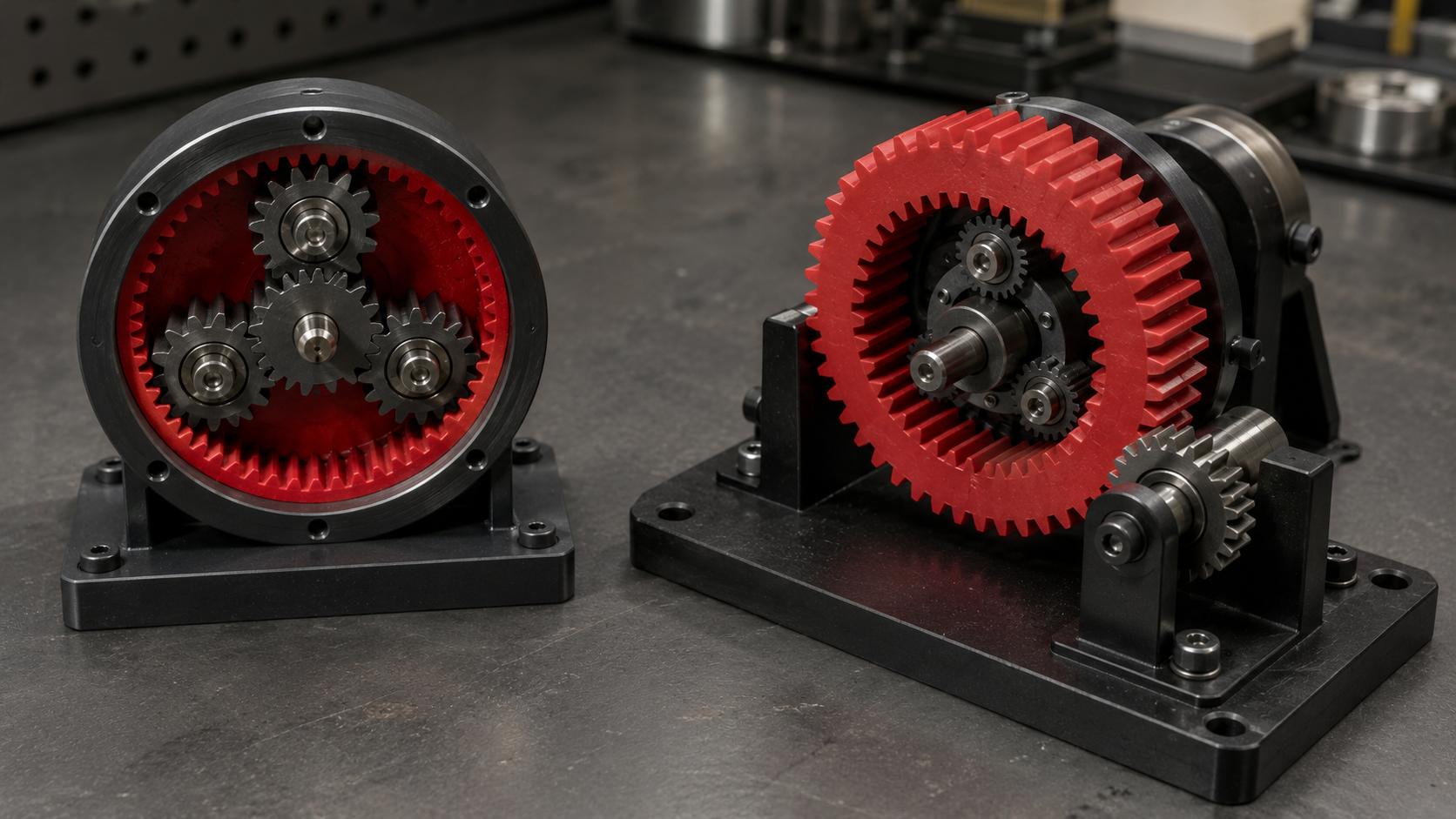
When an ordinary spur gear cannot solve the problem
An internal ring gear is required when a pinion or a group of planet gears must run inside a toothed ring. Common reasons for searching include replacing an unavailable plastic gear, prototyping a planetary gearbox, building a compact transmission or creating a ring gear that also has external teeth. The required diameter is only part of the specification: module, tooth count, pressure angle, backlash and wall thickness must work together.
BuildYour3D provides two related configurations:
- Internal-only ring gear: involute internal teeth with a configurable outer rim.
- Combined ring gear: internal teeth and optional external teeth on the same ring.
What is the real search intent behind “internal ring gear”?
Most users are not looking for a dictionary definition. They want to generate a usable model, reproduce an existing gear or understand why two gears will not mesh correctly. Relevant searches include:
- custom internal ring gear
- internal gear generator
- ring gear calculator
- planetary gearbox ring gear
- 3D printed internal gear
- internal gear STL generator
- calculate gear module and teeth
- internal external ring gear
- 3D printed replacement gear
- backlash for 3D printed gears
The shared goal is to turn a defined gear specification into an inspectable 3D model without rebuilding the full tooth geometry manually.
Which ring gear configurator fits your project?
| Version | Choose it when … | Key feature |
|---|---|---|
| Custom Internal Ring Gear | gears only need to mesh on the inside of the ring. | Configure module, internal teeth, face width, outer rim thickness, pressure angle, backlash and profile shift; enter a mating-gear tooth count for an interference check. |
| Internal Gear with Optional External Teeth | the ring must mesh with separate gear sets on its inner and outer circumference. | Internal and external modules and tooth counts are independently adjustable; an internal-only mode is also available. |
Configure an internal-only ring gear
Set the module, internal teeth, face width, outer rim, pressure angle, backlash and profile shift, then check the intended mating gear.
Gear module: the starting point for tooth size
The metric module m defines the size and spacing of the teeth. For a straight metric gear, the basic pitch-diameter relationship is:
Pitch diameter d = module m × number of teeth z
A module 1 gear with 40 teeth therefore has a pitch diameter of 40 mm. The outside, tip and root diameters are different values. An internal gear and its directly mating external gear must use the same module.
On the combined ring gear, the internal and external modules may differ because the two circumferences can mesh with separate gear sets. Within each individual gear mesh, however, the mating gears still need matching modules.
Choosing internal teeth and mating-gear teeth
The internal tooth count works with the module to determine the size of the ring gear. The external pinion running inside the ring must have fewer teeth. For an unmodified pair using the same module, the theoretical centre distance is:
Centre distance a = m × (zring − zpinion) / 2
This is a basic geometric relationship, not a complete interference or load-capacity calculation. If the difference between the tooth counts becomes too small, tooth tips, roots or flanks may interfere. The “Mating Gear Teeth” input in the internal-only configurator helps identify critical combinations during model generation.
Pressure angle: mating gears must match
The pressure angle describes the direction of force transmission at the tooth flank. A value of 20° is common for modern involute gears, but the essential rule is that the internal ring gear and its mating gear must use the same pressure angle.
When reproducing an existing replacement gear, do not estimate the pressure angle from a photograph alone. If no drawing or manufacturer specification is available, make a small test section or prototype before producing the complete part.
Backlash for 3D-printed gears
Backlash adds clearance between tooth flanks. Without sufficient clearance, print tolerances, slight over-extrusion, seam artifacts or inaccurate centre distances can cause the gear pair to bind. Excessive backlash, on the other hand, increases lost motion, noise and uneven running.
There is no universal backlash value for every printer and material. The required clearance depends on:
- printer calibration,
- nozzle diameter and layer height,
- material and shrinkage,
- gear module and tooth dimensions,
- shaft alignment and bearing clearance,
- the acceptable amount of lost motion.
For a functional mechanism, a small test pair printed with the final settings provides more useful evidence than a generic clearance recommendation.
Profile shift: when should it differ from zero?
Profile shift changes the position of the tooth profile relative to the standard geometry. For a conventional starting design, 0 is the sensible default. A calculated profile shift can help with unusual tooth counts, centre distances or interference conditions, but it changes several geometric relationships at the same time.
Do not use profile shift as a general “more clearance” control unless the complete gear pair has been designed for it. The dedicated backlash parameter is intended for manufacturing and print clearance.
Face width and outer rim thickness
Face width is the axial thickness of the ring gear. Increasing it provides more flank contact area, but also requires more installation space and printing material. Outer rim thickness is the material remaining outside the tooth roots of the internal-only gear.
A thicker gear or rim does not automatically create a high-load component. Performance also depends on the material, print orientation, perimeters, infill, layer adhesion, temperature, torque, speed, lubrication and shock loading.
Typical uses for an internal-only ring gear
- Ring gear in a planetary gearbox
- Replacement for a broken plastic internal gear
- Rotary mechanism in robotics or model making
- Prototype for a compact transmission
- Fit and function test before another manufacturing process
- Educational model demonstrating internal gearing
A complete planetary gearbox also requires a sun gear, planet gears, a carrier, bearings, correct centre distances and suitable assembly positions. Configuring the ring gear alone does not define the entire planetary transmission.
Combined internal and external ring gear
The compound version has an internal involute gear and can add external spur teeth around the same ring. Motion can then be transmitted through two separate meshes: one gear set operates inside the ring while another pinion engages the outside.
Possible applications include compact experimental transmissions, coaxial mechanisms, robotics, models and custom drives. The actual function depends on the complete bearing and shaft arrangement; external and internal teeth alone do not create a specific ratio.
Understanding separate internal and external modules
The combined configurator provides separate values for “Internal Module” and “External Module”. This is useful because each circumference can work with a different mating gear.
- The gear running inside the ring must match the internal module.
- The gear engaging the outside must match the external module.
- Each module and tooth count define the corresponding pitch diameter.
- The two sets of tooth roots must leave sufficient material between them.
The internal and external modules do not have to be identical unless the intended gear architecture requires it.
Minimum wall between the two tooth systems
When internal and external teeth share one ring, tooth-root regions approach from both sides. The “Minimum Wall Between Teeth” setting maintains a defined material zone between the internal cutting profile and the root circle of the external teeth.
If module, tooth counts and minimum wall are geometrically incompatible, at least one requirement must change. Options may include a different external tooth count, another external module, a different internal tooth count or an adjusted minimum wall. Inspect the preview for unexpectedly thin sections and unrealistic proportions.
When is the internal-only mode sufficient?
If no external pinion needs to engage the ring, internal-only mode avoids unnecessary outer teeth. “Rim Thickness without External Teeth” then controls the material outside the internal tooth roots. For a classic internal ring gear, the dedicated configurator is normally the more focused choice because it includes pressure angle, backlash, profile shift and mating-gear checks. The internal-only mode of the combined model is useful when switching between both constructions within one model family.
Configure a ring gear with internal and external teeth
Define both modules and tooth counts, select the gear configuration, set the face width and preserve the required minimum wall.
Recreating an existing internal gear as a replacement part
When measuring a broken gear, outside dimensions alone are not sufficient. Try to determine:
- The complete internal tooth count.
- The pitch diameter or suitable reference diameters.
- The module from a drawing, mating gear or careful measurement.
- The pressure angle and any known profile shift.
- The face width and outer rim thickness.
- The mating gear, centre distance and shaft arrangement.
- The backlash required for the intended manufacturing process.
The formula m = d / z uses the pitch diameter, not simply any diameter that is easy to measure with calipers. An incorrect module or pressure angle may produce a part that looks similar but runs poorly or does not mesh.
Checklist before downloading the STL or ordering
| Check | Why it matters |
|---|---|
| Module for each mesh | Gears with different modules cannot mesh correctly. |
| Pressure angle | It must match between the relevant mating gears. |
| Tooth counts | They define pitch diameters, centre distances and ratios. |
| Backlash | It compensates for manufacturing and assembly tolerances. |
| Mating-gear check | It helps identify geometric interference early. |
| Rim or minimum wall | It prevents obviously thin areas between tooth contours. |
| Face width | It must fit the available space and mating-gear width. |
| Print orientation | It affects dimensional accuracy, surfaces and layer loading. |
Materials and limits of 3D-printed gears
PLA is often useful for fit checks, demonstrators and lightly loaded mechanisms. PETG may suit tougher prototypes, while other materials can offer advantages for heat, friction or environmental exposure. Material name alone does not determine service life.
Higher torque, continuous duty, high speed, heat, safety-related functions or inaccessible installations require engineering assessment and testing. A 3D-printed prototype is not automatically equivalent to a manufactured and rated industrial gear.
FAQ about internal ring gears
What is an internal ring gear?
It is a ring-shaped gear with teeth on its inner circumference. A pinion or several planet gears run inside it.
Must the ring gear and mating gear have the same module?
Yes. Gears that directly mesh require matching modules and compatible pressure angles.
How is pitch diameter calculated?
For metric spur gears, the basic relationship is d = m × z, where d is pitch diameter, m is module and z is tooth count.
Why do 3D-printed gears require backlash?
Backlash provides clearance for print, material and assembly tolerances. Without sufficient clearance, the pair may bind.
What is the difference between rim thickness and minimum wall?
Rim thickness lies outside an internal-only gear. Minimum wall is the material left between internal and external tooth-root regions on a compound ring gear.
Can internal and external modules be different?
Yes, when the two tooth systems work with different gear sets. Each direct mesh must still use matching modules.
Can I download the model as an STL?
Yes. After configuration, the generated model can be downloaded as an STL or ordered as a 3D-printed part.
Is the ring gear automatically suitable for high loads?
No. Suitability depends on geometry, material, print quality, bearings, torque, speed, temperature and the consequences of failure.
Conclusion
A functional internal ring gear requires more than an inside and outside diameter. Module, tooth count, pressure angle, backlash, face width and available wall thickness form one connected specification. The dedicated internal ring gear is suited to classic internal gearing and includes a mating-gear check. The combined version is intended for designs where separate gear pairs engage the inside and outside of the same ring.
Online configuration speeds up the path to a 3D model, but it does not replace strength, lifetime or safety calculations. For replacement parts and working prototypes, start with a test print and check meshing, centre distance and backlash under realistic assembly conditions.
Nächster Schritt