


Ventilation & Covers ·
Custom Vent Grilles: Choosing the Right Cover for a PC Fan, Cabinet or Pipe
A custom vent grille should fit the opening without choking airflow. This practical guide compares PC fan guards, perforated covers, flanged slot grilles and round pipe rosettes, including what to measure before downloading the STL or ordering a print.
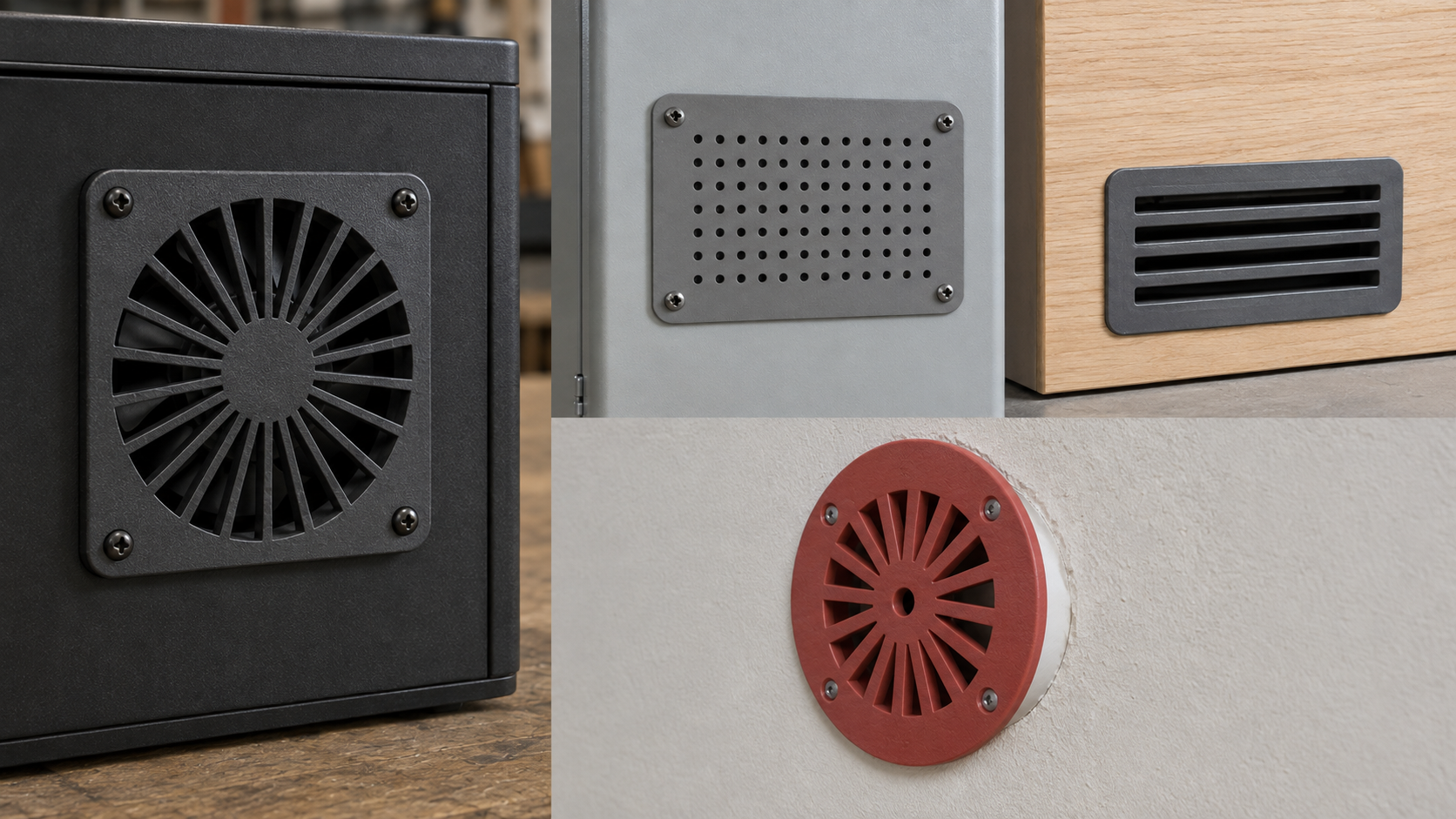
A vent grille looks like a simple part until you try to replace one. The outside dimensions may be right while the mounting holes are wrong. A cover may hide the cut-out but restrict far more airflow than expected. On a PC fan, an unsuitable grille can even add an irritating airflow noise.
This is where a parametric 3D model is useful. Instead of searching for the closest standard size, you enter the required dimensions in the browser, check the 3D preview and then download the generated STL or order the finished 3D print. No CAD software is required.
This guide answers the real question behind searches for a custom vent grille, 3D printed fan guard or vent cover STL: which style suits the job, and what should you measure before configuring it?
Four grille styles for four different jobs
| Grille type | Typical uses | Main measurements |
|---|---|---|
| PC fan grille | PC, NAS, server, power supply and electronics enclosure | Fan size, mounting-hole spacing, blade clearance and open area |
| Perforated vent cover | Control box, equipment housing, cabinet panel and flat opening | Outside width and height, border, hole diameter and mounting |
| Flanged slot grille | Furniture plinth, cabinet door, workshop bench and wall opening | Cut-out, flange overlap, slot direction and air gap |
| Round pipe vent rosette | Ventilation pipe, circular wall opening and furniture passage | Actual pipe diameter, insertion clearance, flange and bolt circle |
These parts are not interchangeable. A powered fan needs safe blade clearance and matching screw positions. A furniture opening often needs a broad flange to hide the edge of the cut-out. A round pipe is usually easier to centre with an insertion ring than with a rectangular plate.
1. A custom grille for 80, 92, 120 or 140 mm PC fans
People searching for a 120 mm fan grille, a PC fan guard or a printable fan-cover STL usually want to keep cables and fingers away from the blades without sacrificing cooling. The parametric PC grille can be adjusted by fan size and hole distance, with further controls for thickness, frame width, screw-hole diameter, countersinks, spoke count and width, centre ring and corner radius.
Do not assume that the nominal fan size is also the mounting-hole distance. Measure the screw pattern centre to centre, or use the fan manufacturer's drawing. Check which side of the fan receives the grille and look for projecting blades, cable ties, screw ends or anti-vibration mounts. The printed grille must remain clear of the rotor in every operating position.
More spokes are not automatically better. Thick or closely spaced spokes reduce the open area. Placed directly in front of a fast fan, they can also create turbulence and extra noise. For a quiet PC, NAS or home server, a stable but relatively open design is generally more useful than a dense decorative pattern.
Configure a grille for your PC fan
Set the fan size, mounting distance, spokes, centre ring and screw holes to suit the actual fan.
2. A perforated vent cover for enclosures and cabinets
A flat perforated panel works well when a rectangular opening needs a tidy, protective cover. Common examples include electronics boxes, small control cabinets, equipment housings and ventilated cabinet sides. Width, height, material thickness, border, hole diameter and optional mounting holes can be configured.
Take two separate measurements: the opening itself and the required outside size of the cover. The border must overlap the cut-out on every side and still leave enough solid material around the mounting screws. For example, a 120 × 80 mm cover centred over a 100 × 60 mm opening provides roughly 10 mm of overlap per side.
The number of holes alone does not tell you how well the cover will breathe. Small holes stop larger objects more effectively, but their combined open area may be limited. Larger holes usually improve airflow, but they do not make the part a certified finger guard. A printed perforated cover is also not automatically an insect screen or dust filter. Add a suitable mesh or filter behind it when required, and remember that this creates additional airflow resistance.
Create a perforated cover to fit the opening
Adjust the panel size, material thickness, border, ventilation-hole diameter and mounting option.
3. A flanged slot grille for furniture and rectangular cut-outs
A cabinet ventilation grille often has to do more than pass air. It may also need to hide the edge of a jigsaw cut-out. A rectangular slot grille with a surrounding flange is better suited to this job than a completely flat perforated plate. Adjustable values include grille width and height, thickness, frame, flange, horizontal or vertical direction, slat width, air gap, mounting holes, countersinks and corner radius.
It is important to distinguish the ventilation area from the total outside size. On this model, grille width and grille height describe the active grille area; the frame and flange extend beyond it. First measure the cut-out, then check the maximum space available for the visible flange. In a narrow kitchen plinth or cabinet door, an oversized flange may collide with a panel edge, hinge or floor trim.
Slot direction is not purely decorative. Horizontal slots tend to look natural in a long furniture plinth and can reduce the direct view into the cabinet. They are not a substitute for a weather louvre, however. A 3D-printed grille is not automatically rainproof and should not be treated as a certified exterior vent.
For passive cooling, give warm air somewhere to leave. A low inlet combined with a higher outlet normally supports natural convection better than one large grille in the middle. If electronics are enclosed, check the real operating temperature rather than assuming that a particular grille size guarantees adequate cooling.
Size a slot grille for furniture or an enclosure
Match the grille area, flange, slot direction, air gap and fixing holes to the existing cut-out.
4. A round vent rosette for a pipe or wall opening
A round pipe vent cover is useful where a circular duct or hole meets a wall, panel or piece of furniture. Its broad face covers the edge of the opening, while an optional insertion ring can centre the part on the pipe. The configurable dimensions include pipe diameter and clearance, outside diameter, thickness, insertion-ring depth and wall thickness, spoke count and width, centre ring, optional mounting holes, bolt circle and countersinks.
Do not rely only on the nominal size printed on the pipe. Measure the actual diameter where the insertion ring will sit. Plastic pipe can be slightly oval, and paint, burrs or seams may change the fit. Take several measurements around the circumference. The correct clearance then depends on the printer, material, part size and whether you want a sliding or firm fit. For a critical fit, a short test ring is cheaper than reprinting the complete rosette.
The outer flange must fully cover the wall opening. Mounting holes need enough material between the hole and both edges. A countersink also has to match the screw head and plate thickness; making it too deep can leave a weak fixing point.
Finish a round pipe opening neatly
Set the real pipe diameter, insertion clearance, flange size, spokes and mounting pattern in the browser.
How to measure a vent opening
- Measure the opening: record width and height, or the pipe diameter, at more than one point.
- Plan the overlap: decide how far the frame or flange must cover the cut edge.
- Look behind the panel: check for fan blades, cables, ribs, filters, hinges and pipe edges.
- Record the fixings: measure hole spacing from centre to centre and note screw diameter and head style.
- Review the full airflow path: an outlet grille cannot help much if there is no suitable inlet.
- Check the preview: verify total dimensions, wall thicknesses and hole positions before downloading or ordering.
A practical habit is to photograph the installation with a ruler in the frame and write the dimensions down separately. A photo on its own is rarely enough to recover an exact millimetre measurement later.
Free area matters more than the outside dimensions
The overall size of a grille says little about the amount of air that can pass through it. What matters is the combined open area of the holes, slots or spoke gaps. Frames, centre rings, filters and components mounted close behind the grille all increase resistance.
On a powered fan, a restrictive cover can reduce airflow and change the sound. With passive ventilation, it slows natural air exchange. Cooling performance therefore cannot be guaranteed from configurator dimensions alone. For temperature-sensitive or high-powered equipment, measure the temperature under real load and adjust the opening, fan or filter if necessary.
Choosing a 3D-printing material
- PLA is easy to print and often adequate for prototypes or moderate indoor temperatures. It can soften in hot equipment, vehicles or direct sun.
- PETG is a practical choice for many tougher indoor applications and generally tolerates more heat than ordinary PLA.
- ASA may suit UV-exposed outdoor applications better, but the material name alone does not make a grille weatherproof, fire-rated or certified.
For power supplies, machinery, escape routes, fire-rated assemblies or other safety-critical installations, requirements may apply to flammability, access protection and certification. Use an individually printed part only after the application has been properly assessed.
Download the STL or order the printed part?
If you have a 3D printer, download the STL after checking the model preview. Open it in Bambu Studio, Cura, PrusaSlicer or another slicer and verify scale, orientation, wall count and material profile. Many flat grilles can print without supports, although good bed adhesion and dimensionally accurate holes remain important.
If you do not own a printer, you can order the physical 3D print instead. This avoids slicer setup, but it does not remove the need to measure carefully. A perfectly printed grille with the wrong hole spacing is still the wrong part.
Frequently asked questions
Can I create a custom-size vent grille as an STL?
Yes. Each model is generated from the dimensions entered in the browser. You can then use the STL for your own printer or continue with the 3D-print ordering option.
Which grille fits a 120 mm PC fan?
Use the custom PC fan grille and choose the matching nominal fan size. Always verify the actual centre-to-centre mounting distance and make sure the guard cannot touch the blades.
Is a printed vent grille also a dust filter?
No. Holes, slots and spokes stop only larger objects. Fine dust and insects require a suitable filter or mesh behind the grille, and that extra resistance must be considered.
Can I use a 3D-printed vent grille outdoors?
Only after checking the material, UV exposure, temperature, water direction and mounting position. These models are not automatically rainproof, fire-rated or approved exterior vents.
How much clearance does an insertion ring need?
That depends on the printer, material, part size and desired fit. Measure the pipe at several points and print a small test ring when the fit is important.
Conclusion: choose the grille around the installation
For a PC fan, focus on mounting distance, blade clearance and open area. For a flat enclosure cover, the outside size, border and perforation pattern matter most. A furniture cut-out benefits from a flange and correctly oriented slots. At a round pipe, the measured diameter, insertion clearance and face diameter determine whether the result looks neat and fits properly.
Once those differences are clear, a configurable model becomes more than a random STL. Measure the opening, plan the full airflow route, check the fixing points and then use the product that matches the actual installation.