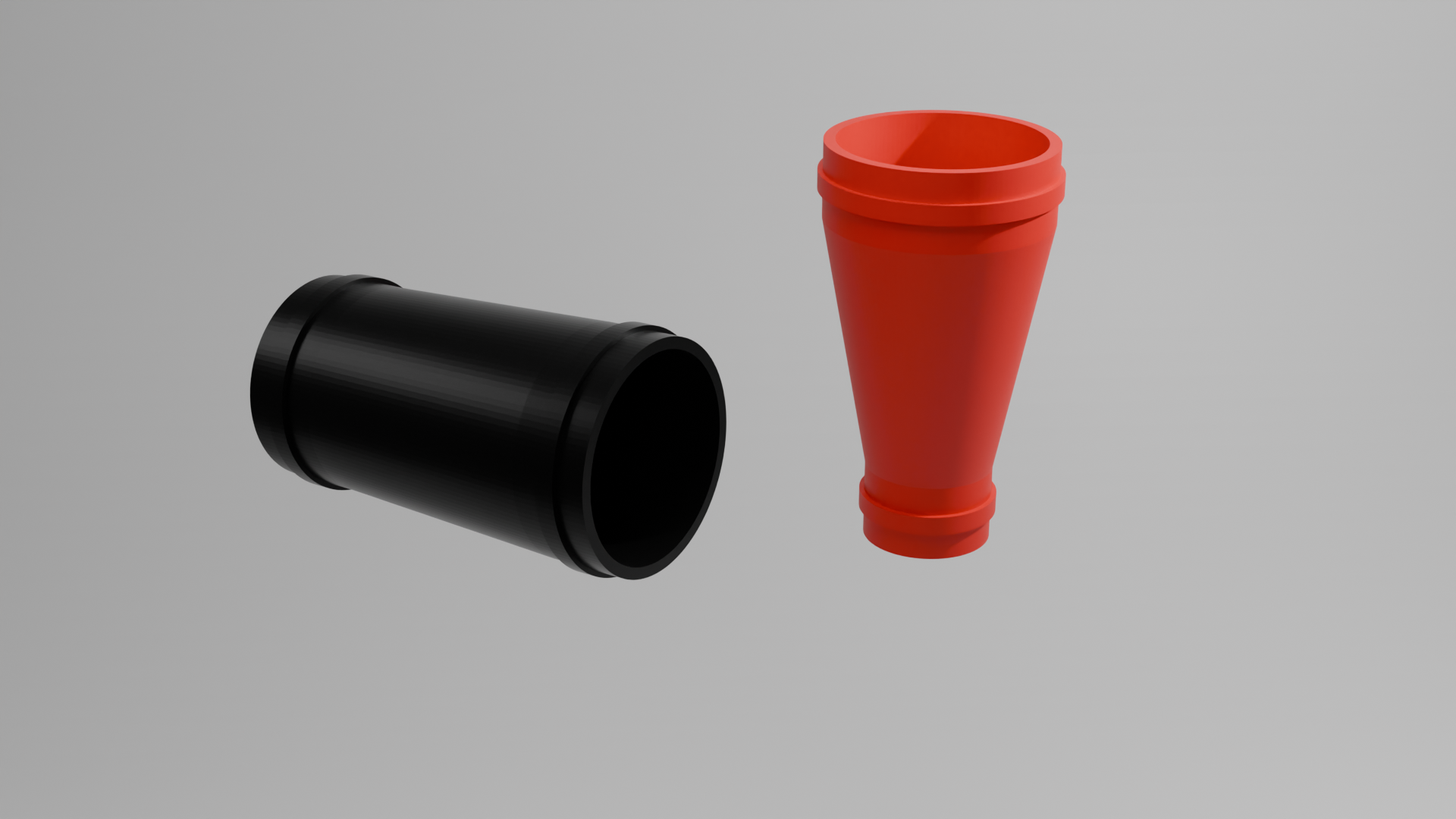


Adapter ·
Custom Vacuum Hose Adapters – How to Connect 32, 35 and 38 mm Dust Ports
Configure a custom vacuum hose and dust-extraction adapter for 30, 32, 35, 36 or 38 mm connections. Learn how to measure ports, tune fit, choose materials and download or order the 3D-printed adapter.
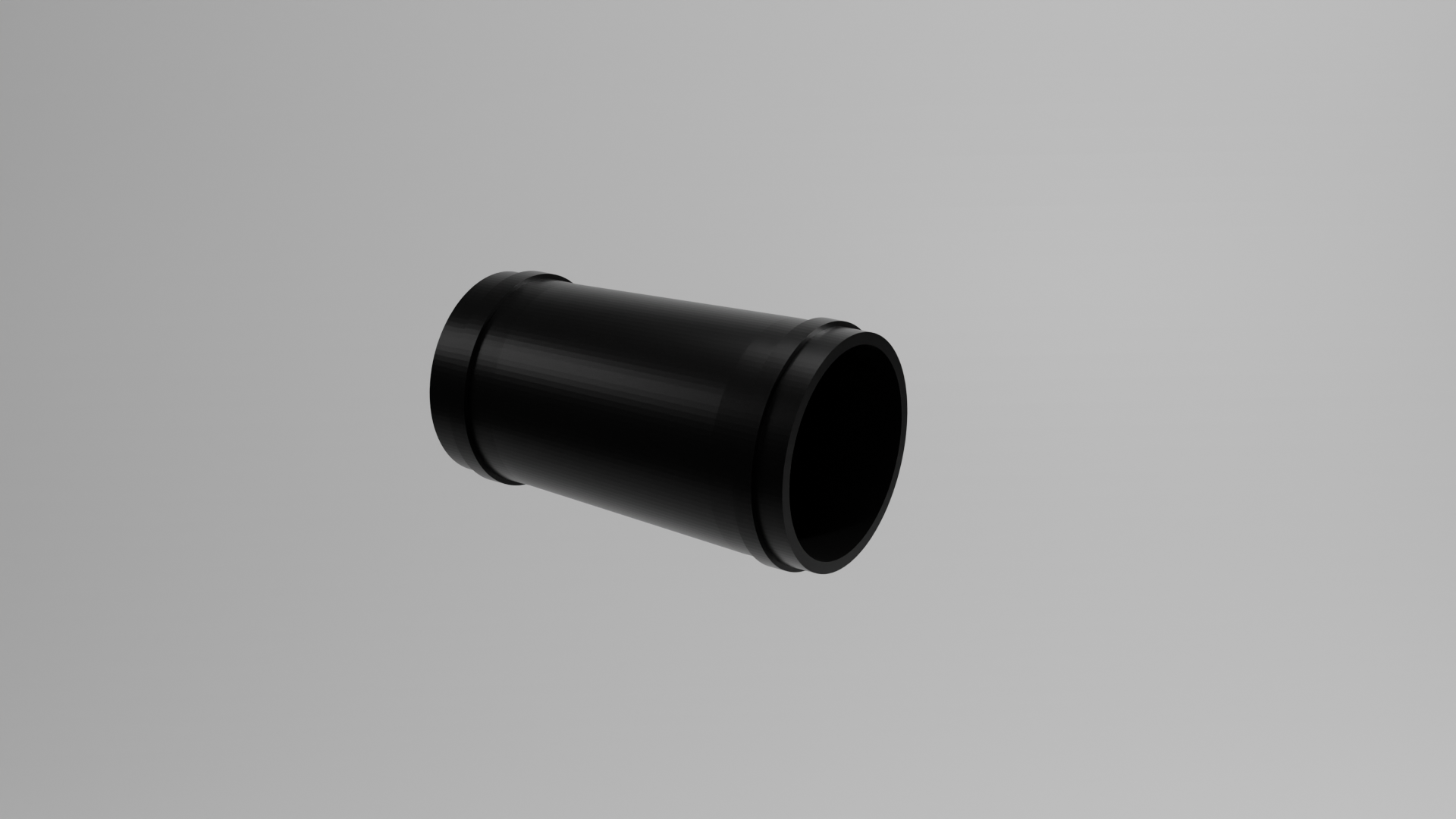
🔧 Configure a custom vacuum hose adapter online
Your vacuum hose measures 32 mm, the dust port on your power tool is 35 mm, the saw outlet falls somewhere in between, or accessories from two brands refuse to fit even though the stated size looks identical: incompatible vacuum and dust-extraction connections are a common workshop problem.
The parametric Custom Vacuum Hose Adapter from BuildYour3D lets you create the exact transition directly in your browser. Both connection diameters, insertion length, wall thickness, taper length, retention beads and fit compensation can be adjusted without CAD knowledge.
- Measure both real connections with calipers.
- Enter the diameter for end 1 and end 2.
- Adjust insertion length, wall thickness and transition length.
- Configure retention beads and independent fit compensation if required.
- Check the 3D preview, then download the STL or order the printed part.
Why vacuum hoses and dust ports often do not fit
Vacuum cleaners, shop vacuums and power tools commonly use round push-fit connections. That sounds simple, but in practice manufacturers use many diameters, wall thicknesses and connection styles. Even familiar nominal sizes such as 32, 35 or 38 mm are not always comparable because one manufacturer may quote the outside diameter of a port while another refers to the inside diameter of a hose or cuff.
Fine size differences, tapered ports, locking tabs, bayonet fittings and product-specific geometry add further complexity. A hose sold as 35 mm may therefore be loose, excessively tight or completely incompatible with a tool also described as 35 mm.
Typical problems include:
- The hose is only a few tenths of a millimetre too large or too small.
- The power tool uses an unusual intermediate diameter.
- One dimension is an inside diameter and the other an outside diameter.
- The available engagement surface is too short.
- A universal rubber reducer slips off under hose tension.
- An abrupt internal step reduces airflow.
- Accessories from different brands or product generations do not connect.
The most common searches: 32, 35 and 38 mm vacuum adapters
Adapters for 32, 35, 36 and 38 mm connections are among the most frequently requested workshop fittings. Common searches include:
- 32mm to 35mm vacuum adapter
- 35mm to 32mm vacuum hose adapter
- 35mm to 38mm dust extractor adapter
- 38mm to 35mm vacuum hose reducer
- 32mm shop vac adapter
- 35mm power tool dust adapter
- 30mm vacuum hose connector
A rigid adapter kit with a few nominal steps solves only part of the problem. A parametric adapter can also be configured as 31.6 to 34.8 mm, 36.2 to 38.5 mm or any other measured size within the model range. Those intermediate dimensions are often the key to adapting older machines, imported tools or accessories from different product lines.
How to configure a 32mm to 35mm vacuum adapter
A 32-to-35 mm reducer is one of the most common use cases. It can connect a smaller vacuum hose to a larger tool port or the reverse, depending on how the hose and fitting are arranged.
In the configurator, set:
- end 1 to 32 mm;
- end 2 to 35 mm;
- the required insertion length;
- the desired wall thickness;
- and independent fit compensation where necessary.
Do not automatically enter the nominal number printed on the hose or tool. Measure the actual mating surface. A part described as 32 mm can differ noticeably depending on where and how the manufacturer measured it.
Adapters for shop vacuums and wet/dry vacuums
Workshop vacuums are often moved between several tools. Sanders, circular saws, jigsaws, routers, planers and CNC machines may all use different dust-port diameters. A custom adapter avoids the need for a dedicated hose for every machine.
Typical connections include:
- shop vacuum to random orbital sander
- wet/dry vacuum to circular saw
- vacuum hose to router dust port
- dust extractor to planer
- CNC dust shoe to cyclone separator
- hose to custom dust hood
- power tool outlet to a central workshop extraction system
Power tool dust-port adapters
A correct dust-extraction connection is not only a matter of convenience. It reduces airborne dust, improves visibility around the cutting area and prevents the hose from repeatedly falling off the tool.
An adapter that is too loose leaks air and disconnects under movement. One that is too tight can crack a thin plastic tool port. The model therefore includes separate dimensional compensation for both ends.
Independent fit compensation for both sides
Fit Compensation End 1 and Fit Compensation End 2 adjust the printed outside diameter independently:
- A negative value makes the end smaller and looser.
- A positive value makes the end larger and tighter.
- A value of 0 preserves the entered diameter.
For reliable calibration, print a short test ring or a shortened sample adapter before producing the final full-length part.
Kärcher, Bosch, Makita, Festool, Dyson, Nilfisk and other brand adapters
Users often search for a Kärcher hose adapter, Bosch dust adapter, Makita vacuum adapter, Festool hose adapter, Dyson adapter, Nilfisk adapter or Parkside vacuum fitting.
This model is deliberately brand-independent. It is configured from measured diameters, which means it can be suitable for many tools and accessories when both connections are round push-fit interfaces.
Universal brand compatibility should never be assumed. Manufacturers may use different diameters, tapers and locking systems across product ranges and model years. Always measure the exact hose, cuff or port you intend to connect.
Inside diameter or outside diameter: what should you measure?
The correct measurement depends on which component slides over the other.
The printed adapter slides into a hose
Measure the inside diameter of the hose or flexible cuff. The printed end will form the corresponding outside diameter.
The printed adapter must slide over an existing port
The current configurator primarily generates external push-fit ends. If the printed part needs to surround an existing rigid port as a true female socket, a dedicated female-coupler geometry is preferable.
Flexible hoses may not be perfectly round
Soft or aged hoses can become oval. Measure in several directions and at more than one point rather than relying on a single reading.
How to measure a vacuum connection correctly
- Use calipers: A ruler is not accurate enough for close push-fit tolerances.
- Measure more than once: Check the diameter in several orientations.
- Measure the mating surface: Avoid beads, decorative rings, bayonet tabs and locking features.
- Check insertion depth: Determine how much straight contact length is actually available.
- Check for taper: Some tool ports become smaller toward the tip.
- Print a test piece: A short calibration ring uses little material and confirms the fit quickly.
What do the retention beads do?
The circular retention beads improve grip inside flexible vacuum hoses. When the hose is pushed over the bead, it stretches slightly and is held behind the raised section.
The important bead settings are:
- Retention Bead Height: radial increase above the normal connection diameter.
- Retention Bead Width: axial width of the raised section.
A more pronounced bead can work well with soft hoses. For rigid tubes, brittle cuffs or already tight fits, reduce the bead height or set it to 0.
Why use a tapered transition instead of an abrupt step?
The adapter uses a tapered central section between the two connection ends. This distributes the diameter change over a longer distance and creates a smoother internal airflow path.
A longer transition:
- reduces abrupt internal steps;
- can reduce turbulence;
- spreads the diameter change over more length;
- but increases the total size of the adapter.
A shorter transition is useful where space is limited. Larger diameter differences usually benefit from a longer taper.
What wall thickness should you choose?
The best wall thickness depends on diameter, material and mechanical load.
- 1.2–1.8 mm: lightweight adapters and fit prototypes.
- 1.8–2.5 mm: a practical range for many workshop fittings.
- 2.5–3.5 mm: robust parts that are connected and removed frequently.
- Above 3.5 mm: generally only necessary for large diameters or higher mechanical loads.
Increasing wall thickness improves stiffness but reduces the free internal airflow area. The configurator generates the inner channel from the selected outside diameters and wall thickness.
How much insertion length is useful?
A longer straight insertion zone usually improves alignment, grip and sealing area. It also requires enough free space on the hose or tool connection.
Ten to twenty millimetres is a useful starting range for many workshop applications. Short tool ports may require less. Flexible hoses often benefit from a longer contact surface.
Custom vacuum adapter versus universal stepped reducer
Universal rubber reducers and stepped adapters are widely available, but they have limitations:
- They support only fixed size steps.
- They may be unnecessarily long or bulky.
- The inner airflow path can be heavily restricted.
- Both sides rarely fit equally well.
- They may slip off when the hose is pulled.
A parametric adapter is generated specifically for the two measured connections. Diameter, length, wall thickness and fit can be tuned for the actual tool and hose.
Benefits of the online configurator
- ✅ Independently adjustable connection diameters
- ✅ Supports unusual intermediate and legacy sizes
- ✅ Separate fit compensation for each end
- ✅ Adjustable insertion and taper length
- ✅ Optional circular retention beads
- ✅ Adjustable wall thickness
- ✅ Fast browser preview
- ✅ No CAD knowledge required
- ✅ STL suitable for Bambu Studio, Cura or PrusaSlicer
- ✅ Option to order the 3D-printed part
Download the STL and print it yourself
After configuration, the model is generated from the selected parameters. The STL can be prepared in common slicers such as Bambu Studio, Cura or PrusaSlicer.
Before printing, review:
- part orientation;
- wall or perimeter count;
- layer height;
- material;
- fit compensation;
- support requirements;
- seam position.
Order the custom vacuum adapter printed
If you do not own a 3D printer, the configured adapter can be ordered through BuildYour3D. The selected browser parameters define the custom part used for the print order.
This is particularly useful for repairs, workshop projects, custom accessories and uncommon connection diameters where no suitable catalogue part is available.
Which material is best for a vacuum hose adapter?
PETG
PETG is a practical default for many workshop vacuum adapters. It is tougher and generally more heat-resistant than standard PLA and usually tolerates repeated connection cycles better.
ASA
ASA is a good option for parts exposed to sunlight, elevated temperatures or outdoor conditions.
TPU
TPU is flexible and can be useful for compliant couplings, sealing sleeves and vibration-prone connections. Fit behaviour differs substantially from rigid filaments.
PLA
PLA works well for dimensional samples and lightly loaded applications. It can soften or deform sooner in hot workshops, vehicles or direct sunlight.
Print orientation and strength
Print orientation affects roundness, surface quality and strength. Printing the adapter upright often requires little support and produces clean circular geometry, but lateral bending can load the layer interfaces.
For workshop fittings, several perimeters are often more useful than an extremely high infill percentage. The best settings depend on the printer, filament and expected load.
Typical applications
- connecting vacuum hoses with different diameters
- connecting a shop vacuum to a sander
- dust extraction for circular saws and jigsaws
- connecting a router to a vacuum hose
- adapting a CNC dust shoe to a hose
- connecting a cyclone separator to a shop vacuum
- adapting a wet/dry vacuum to a tool port
- reusing older accessories with a newer vacuum
- connecting accessories across brands
- creating a special fitting for a custom dust hood
FAQ: custom vacuum hose adapters
What vacuum hose diameters are common?
Common nominal sizes include 30, 32, 35, 36 and 38 mm. Many intermediate and manufacturer-specific sizes also exist.
Can I configure a 32mm to 35mm adapter?
Yes. Set end 1 to 32 mm and end 2 to 35 mm, then verify the actual measured dimensions before printing.
Can I create a 35mm to 32mm adapter?
Yes. Both ends are independent, so the order can be reversed.
Will it fit Kärcher equipment?
It can be configured for a specific round Kärcher connection if the real dimensions are measured. It is not universally compatible with every Kärcher model.
Will it fit Bosch, Makita, Festool, Dyson or Nilfisk?
The model is brand-independent. Compatibility depends on the actual diameter, taper and connection style of the specific product range.
How do I measure a vacuum hose?
Measure the inside diameter where the hose or cuff will slide over the printed adapter. Check several orientations because flexible hoses can be oval.
What does fit compensation mean?
It changes the printed outside diameter of the selected end. Negative values loosen the fit; positive values tighten it.
What is the retention bead for?
It improves mechanical grip inside flexible hoses. It can be disabled for rigid tubes or sensitive connections.
How long should the insertion section be?
Ten to twenty millimetres is useful for many applications, but the available depth of the real connection is the deciding factor.
Can I configure the adapter without a bead?
Yes. Set the retention bead height to 0.
Can I enter a non-standard size?
Yes. Diameters can be entered in fine increments, allowing unusual intermediate measurements.
Can I download the STL?
Yes. The model is generated from your parameters and can be downloaded for your own 3D-printing workflow.
Can I order the adapter printed?
Yes. The configured model can also be used to start a 3D-print order through BuildYour3D.
Which material should I choose?
PETG is a good starting point for many workshop adapters. ASA is better for UV and heat exposure, while TPU is useful for flexible connections.
Should I print a fit test first?
Yes. A short calibration ring uses little material and quickly confirms the diameter and fit compensation.
Configure your custom vacuum hose adapter now
Measure both connections, enter the diameters and fit values, and inspect the generated model directly in your browser. You can then download the STL or order the adapter printed.
Nächster Schritt
Bereit für den nächsten Schritt?