

Hydraulic parts ·
One Tube, Endless Possibilities: 10 Practical Custom Parts You Cannot Find in the Hardware Store
Configure a custom tube online by outer diameter, inner diameter and length. Create spacers, distance sleeves, bushings, handles, protective sleeves and replacement parts, then download the STL or order the 3D print.
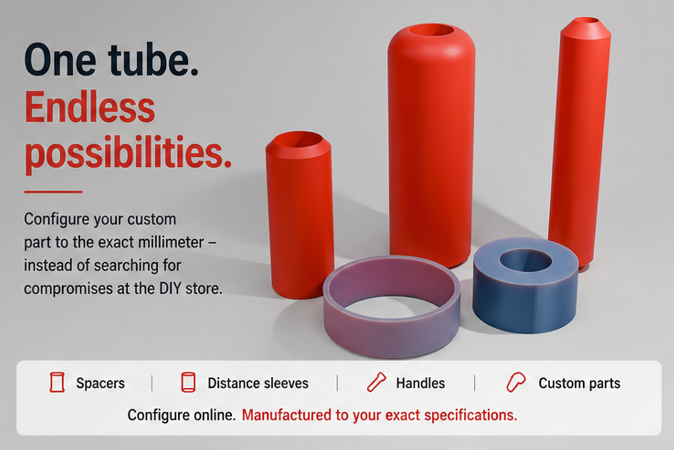
One tube. Endless possibilities.
Configure a custom tube to the exact millimetre instead of settling for an off-the-shelf compromise. Enter the outer diameter, inner diameter and length, check the live 3D preview, then download the STL or order the finished 3D-printed part.
Custom tube dimensions when the hardware store has nothing that fits
A standard tube is easy to find. A tube that must fit an existing shaft, screw, bearing, enclosure, bracket, handle or repair assembly is much harder. Hardware stores and online catalogues usually offer a limited range of diameters and fixed lengths. That is convenient for common construction work, but frustrating when a project requires an exact outside diameter, a specific bore or a spacer that must be only a few millimetres longer or shorter.
The BuildYour3D custom tube configurator solves this problem without requiring CAD knowledge. You define the outer diameter, inner diameter and overall length. The model is generated from those values, displayed in a live preview and prepared for STL download or 3D-print ordering. The same simple geometry can become a spacer, distance sleeve, bushing, handle, protective sleeve, cable guide, shaft cover or a one-off replacement part.
What can a configurable tube be used for?
The word “tube” describes only the geometry. In real projects, that geometry performs many different jobs. A short, thick-walled tube may be a bushing. A long tube may become a hand grip or a protective cover. A wide ring may work as a spacer, collar or locating sleeve. Because all three core dimensions are configurable, one model can solve hundreds of workshop, repair, prototyping and hobby applications.
10 practical custom parts you can create from one tube model
1. Custom spacers for brackets, panels and assemblies
A spacer keeps two components at a defined distance. Typical examples include mounting a panel away from a frame, aligning a sensor, spacing a cover above electronics or preventing a screw from compressing a soft housing. With a custom tube, the length defines the spacing, the inner diameter fits the screw or bolt and the outer diameter provides the required support area.
Search intent examples include custom spacer, plastic spacer tube, spacer sleeve for bolt, mounting spacer and 3D printed spacer. These parts are especially useful when standard spacers are too short, too long or have the wrong bore.
2. Distance sleeves for bolts and threaded rods
A distance sleeve slides over a bolt or threaded rod and transfers compression forces between two surfaces. It can help prevent deformation, stabilise an assembly or establish a repeatable mounting distance. Measure the fastener diameter, allow suitable clearance and choose an outer diameter that gives the sleeve enough wall thickness for the expected load.
3. Bushings and simple plain-bearing prototypes
A tube with a short length and a carefully selected bore can serve as a test bushing, guide bushing or low-load plain-bearing prototype. It may help align a rod, reduce play or protect a softer housing from direct contact with a moving shaft. A 3D-printed bushing is not automatically suitable for high speed, high temperature or continuous industrial service, but it can be valuable for fit checks, prototypes and lightly loaded mechanisms.
4. Handles and grip sleeves
A longer tube can become a handle for a jig, lever, tool, camera rig, drawer prototype or workshop fixture. The inner diameter fits over the existing shaft or bar while the outer diameter determines how the grip feels in the hand. Wall thickness, material, surface texture and print orientation affect stiffness and comfort.
5. Protective sleeves for rods, screws and sharp edges
Protective sleeves cover exposed rods, threaded ends, pins or edges. They can reduce accidental contact, keep dirt away from a surface or protect neighbouring components during transport and assembly. For removable sleeves, include enough clearance to prevent the part from binding.
6. Cable guides and cable pass-through sleeves
A custom tube can guide cables through a panel, frame, enclosure or furniture component. It may act as a simple cable conduit, edge protector or organiser. The bore must accommodate the complete connector when the cable cannot be threaded from an open end. For electrical applications, material selection, heat exposure and insulation requirements must be reviewed separately.
7. Shaft covers and axle sleeves
A shaft cover protects a shaft from dust, contact or minor impact. It can also improve the appearance of a prototype by hiding exposed threaded rod or rough hardware. Measure the largest shaft feature, not only the nominal diameter, and remember that nuts, clips, flats or keyways may require additional clearance.
8. Locating collars and assembly guides
A short tube or ring can help locate one component relative to another. It may centre a part in a recess, guide a tool during assembly or establish a repeatable position on a fixture. These applications often depend on a precise fit, so prototype testing is recommended before ordering a larger quantity.
9. Repair sleeves and replacement inserts
When an original sleeve, insert or tubular plastic component is cracked, missing or no longer available, a configurable tube can reproduce the essential geometry. This is useful for older furniture, workshop equipment, hobby devices, household products and custom machinery. The replacement should be assessed for load, temperature, wear and safety before use.
10. Fit-check and space-check prototypes
Sometimes the goal is not the final part but a fast dimensional test. A low-cost tube prototype can verify whether a bore fits, whether a housing has enough space, whether two parts align or whether a chosen diameter feels right as a grip. Once the measurements are confirmed, the design can be printed again in a more suitable material or transferred to another manufacturing process.
Which dimensions can you configure?
The current BuildYour3D tube configurator uses three core dimensions:
- Outer diameter: the total diameter measured across the outside of the tube.
- Inner diameter: the diameter of the central bore.
- Length: the overall axial length of the tube.
These values determine wall thickness automatically. Wall thickness is half the difference between outer and inner diameter. For example, an outer diameter of 20 mm and an inner diameter of 10 mm produce a 5 mm wall thickness.
How to measure a tube, spacer or sleeve correctly
Accurate measurement is the most important step. A digital caliper is recommended. Measure the mating component directly whenever possible rather than relying on a worn, cracked or deformed original part.
- Measure the maximum outside diameter required by the installation space.
- Measure the shaft, screw, bolt or component that must pass through the bore.
- Measure the required overall length or spacing distance.
- Check whether the part needs a sliding fit, light press fit or generous clearance.
- Confirm that the resulting wall thickness is realistic for the material and load.
Do not assume that a nominal 8 mm rod always measures exactly 8.00 mm or that a printed 8 mm bore will always finish at exactly 8.00 mm. Printer calibration, material shrinkage, layer orientation and post-processing influence the final fit.
Clearance, tolerance and fit
A CAD dimension is not the same as a guaranteed finished dimension. For a sliding fit, the bore normally needs some clearance above the measured shaft diameter. For a press fit, the correct interference depends on material flexibility, geometry, print settings and the mating part. Because these relationships vary, a test piece is often the most reliable solution.
Critical fits should be checked with a short sample before producing a long tube or multiple parts. Also consider whether the tube must slide freely, remain removable, grip by friction or be bonded in place.
Wall thickness and strength
The wall thickness is calculated from the two diameters:
Wall thickness = (outer diameter − inner diameter) ÷ 2
A larger outside diameter or smaller bore produces a thicker wall. Thick walls generally improve stiffness and impact resistance, but they also increase material use, printing time and weight. Thin walls can be useful for covers and guides but may deform under clamping or compression.
Strength depends on more than wall thickness. Material, layer adhesion, print orientation, perimeter count, temperature, load direction and stress concentrations all matter. A printed tube should not be treated as a certified pressure pipe, lifting component or safety-critical machine part without appropriate engineering validation.
Material selection for custom tubes
PLA for visual models and quick dimensional checks
PLA is easy to print and useful for prototypes, fit checks, presentation models and lightly loaded indoor parts. It is less suitable for elevated temperatures, long-term outdoor exposure or applications where the tube must flex repeatedly.
PETG for tougher workshop parts
PETG often provides a useful balance of toughness, layer adhesion and moisture resistance. It can be a practical choice for spacers, guards, sleeves and workshop fixtures. Exact performance depends on the filament and print process.
ASA for outdoor use and higher temperature exposure
ASA offers better weather and ultraviolet resistance than many basic materials. It may be suitable for outdoor housings, protective sleeves and fixtures exposed to sunlight. Printing ASA requires controlled processing and good ventilation.
ABS, nylon and engineering materials
ABS, nylon and reinforced technical materials may offer improved temperature resistance, toughness or wear behaviour. They also require more demanding print conditions. Fibre-filled materials can be abrasive and may produce a rougher bore. For sliding contact, the final surface and dimensional accuracy need special attention.
STL download or printed part
After entering the dimensions, review the 3D preview and displayed measurements. You can then obtain the generated STL for use in common slicers or continue to the 3D-print ordering process. An STL can be opened in software such as Bambu Studio, Cura or PrusaSlicer, where orientation, supports, layer height, infill and material settings are selected.
Print orientation for a tube
A tube is commonly printed standing upright or lying on its side. Upright printing usually produces a cleaner circular bore and avoids support material inside the tube, but a tall narrow part may be less stable during printing. Sideways printing can improve strength for some load directions but often requires support and may reduce roundness.
The best orientation depends on length, diameter, load direction, tolerance and printer capability. For a simple spacer loaded along its axis, multiple perimeters and strong layer bonding are often more important than extremely high infill.
When should you not use a 3D-printed tube?
Do not use an untested printed tube for pressure systems, gas lines, drinking-water certification, medical devices, lifting equipment, vehicle safety systems, high-speed rotating machinery or applications where failure could cause injury or major property damage. Printed parts can contain internal defects and their properties depend heavily on processing.
For fluids, chemicals, food contact or outdoor exposure, verify material compatibility and regulatory requirements. A geometric match alone does not prove functional suitability.
Why configure instead of searching for a standard size?
Searching catalogues makes sense when a standard component already exists. Configuration becomes valuable when:
- the required length is unusual;
- the bore must fit a specific bolt, rod or shaft;
- the outer diameter must match a recess or grip size;
- the original replacement part is no longer sold;
- only one or a few pieces are needed;
- a prototype must be tested before production;
- CAD software is unavailable or unnecessary.
Benefits of the custom tube configurator
- ✅ Enter your own outer diameter
- ✅ Enter your own inner diameter
- ✅ Define the exact overall length
- ✅ Live 3D preview before ordering
- ✅ No CAD knowledge required
- ✅ Generated STL for common slicers
- ✅ Optional 3D-print ordering
- ✅ Useful for prototypes, repairs and one-off parts
Frequently asked questions about custom tubes
Can I order a tube in my own dimensions?
Yes. Enter the required outer diameter, inner diameter and length in the configurator, review the preview and continue to STL download or 3D-print ordering.
Can I use the model as a spacer?
Yes. A short tube is a common spacer geometry. The bore fits over the fastener, the length defines the distance and the outer diameter provides the support surface.
Can I create a distance sleeve for a bolt?
Yes. Measure the bolt diameter, choose suitable clearance, enter the desired sleeve length and select an outer diameter that provides adequate wall thickness.
Can the tube be used as a bushing?
It can be used as a prototype or low-load bushing depending on material, fit, speed and wear. High-load or high-speed bearing applications require engineering validation.
How do I calculate wall thickness?
Subtract the inner diameter from the outer diameter and divide the result by two.
How much clearance should I add to the bore?
There is no universal value. Clearance depends on printer accuracy, material, orientation and the type of fit. A small test piece is recommended for critical dimensions.
Can I download the custom tube as an STL?
Yes. The STL is generated from the dimensions entered in the configurator and can be prepared for use in a slicer.
Can I open the file in Cura, Bambu Studio or PrusaSlicer?
Yes. The generated STL can be imported into common slicers. Check scale, orientation, material and print settings before starting the print.
Can I order the tube already printed?
Yes. After configuration, continue to the 3D-print order flow and calculate the manufacturing price.
Which material is best for a spacer?
That depends on load and environment. PLA can be sufficient for a dimensional sample, PETG for many workshop uses and ASA for outdoor exposure. Safety-critical use requires proper engineering evaluation.
Is a printed tube watertight?
Not automatically. Watertightness depends on material, wall design, printer calibration, layer bonding and post-processing. Do not assume suitability for pressure or regulated fluid systems.
Can I create a handle from the tube model?
Yes. Set the inner diameter to fit the shaft or bar, select a comfortable outside diameter and define the required grip length.
Can I replace a discontinued plastic sleeve?
Often yes, when the original part is essentially tubular. Measure the mating components directly and verify load, temperature, wear and safety before use.
Is the part suitable for outdoor use?
Outdoor suitability depends mainly on material and exposure. ASA may be more appropriate than PLA for ultraviolet and weather resistance.
Can I use the tube for a rotating shaft?
It may be suitable as a cover, guide or low-speed prototype. Wear, heat, balance and retention must be assessed. Do not use an untested printed component in high-speed machinery.
What happens if the inner diameter is too small?
The part may not fit because printed bores can finish slightly undersized. For critical fits, add appropriate clearance or print a short test ring first.
What if I need a chamfer or rounded end?
The current English product page lists outer diameter, inner diameter and length as the adjustable options. Review the live configurator for the currently available parameters.
Can I order several identical parts?
The same configured geometry can be used for repeated production. Before ordering a larger quantity, test one part to confirm fit and performance.
Is this a certified pressure pipe?
No. The configurable model is intended for custom geometry, prototypes, replacement parts and workshop applications. Pressure use requires a separately engineered and certified solution.
Do I need CAD software?
No. The model is generated directly from the dimensions entered in the browser.
Configure your custom tube now
Measure the available space and mating component, enter the outer diameter, inner diameter and length, then check the live preview. Download the generated STL or order the finished 3D-printed part.
Nächster Schritt