


Hobbies, learning & leisure STL guides ·
Three-roller hand tube pump STL: Create a Custom-Size 3D Model
Create a custom-size three-roller hand tube pump STL for your own 3D printer. Check the model controls, measure the fit and buy the generated digital file.
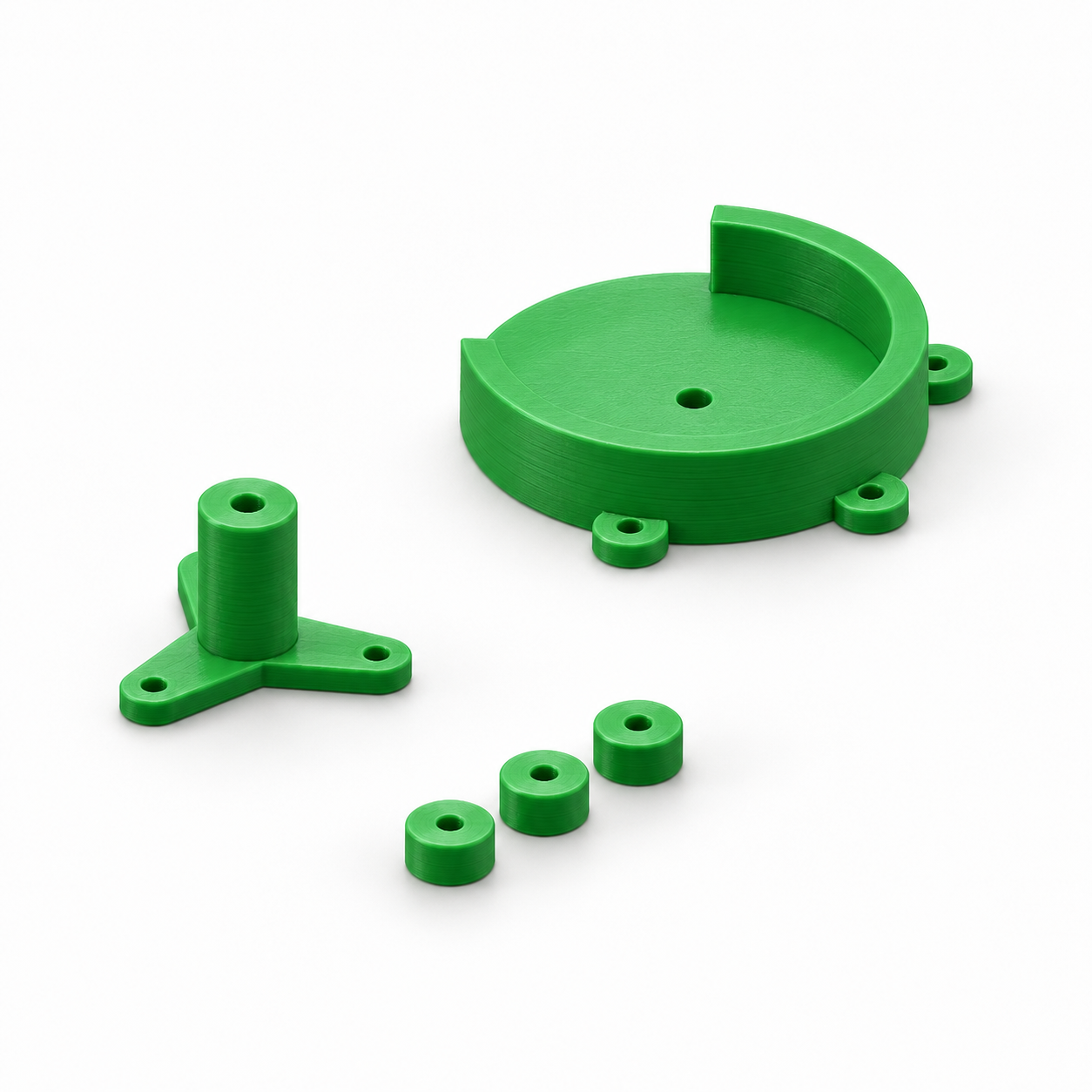
Five printed parts form a manual experimental assembly: housing, rotor with knob and three freely turning rollers. The rollers squeeze a separate soft pump tube against the curved housing wall. Set tube outside diameter, wall thickness and roller radius; defaults are 6 mm, 1.5 mm and 18 mm. The calculated minimum gap is 1.8 times the tube wall thickness, or 2.7 mm by default. This is a starting geometry, not a promise of full tube occlusion or flow rate. Both tube ends pass through the large front opening.
With the Three-roller hand tube pump for water experiments template, you can turn those measurements into a custom-size STL. Review controls such as soft tube outside diameter, wall thickness of your tube, roller axis radius, check your model in the preview and choose the digital file. You buy the generated STL and print it on your own 3D printer, using your preferred filament and slicer settings.
Measurements for your three-roller hand tube pump STL
The product page exposes the following useful geometry controls. Work from your measured parts and check the displayed units and the preview before entering final values.
| Model control | What to check |
|---|---|
| Soft tube outside diameter | Measure the external mating surface; compare it with the receiving opening. |
| Wall thickness of your tube | Check the remaining material around openings and inspect the walls in the slicer preview. |
| Roller axis radius | Check that the value is a radius rather than a diameter and that the curve clears adjacent parts. |
Decide which surface has to fit
A connector that goes inside an opening is measured differently from a sleeve that fits around a tube. Record each mating surface and the available engagement, then distinguish internal dimensions from external ones. Nominal pipe sizes are not always the dimensions you will measure with calipers. Inspect internal overhangs in the slicer so that supports do not become trapped in a bore.
Configure the model, buy the STL and print locally
- Open the three-roller hand tube pump product page and compare the model preview with your application.
- Enter the relevant measurements. Use the units displayed beside each input; convert inch measurements before using a millimetre field.
- Review the complete geometry and keep a record of your parameter values. Check small openings, mating features and remaining wall thickness.
- Choose the digital STL purchase option and review the current price and order details before payment.
- After receiving the STL, open it in your slicer, confirm the imported dimensions and inspect the layer preview before printing.
Configure my three-roller hand tube pump STL
Check a first print before making more
A CAD dimension and a printed dimension can differ. Print a fit sample or one prototype before making a batch, and check the features that contact other parts. Choose print orientation, supports and material for the actual geometry and application. There is no universal clearance or print profile that guarantees the fit on every machine.
Before you choose your STL
Why configure the model instead of scaling a download?
Uniform scaling changes all dimensions together. Here you can work with the available controls, including soft tube outside diameter, wall thickness of your tube, roller axis radius, and check the result before purchase. Keep your input values for later revisions: the downloaded STL contains the final mesh, rather than the original parametric editing history.
What do I buy?
Select the digital STL option for the file you will print yourself. Review the current price and selected configuration before paying. Ordering a finished print is a separate option.
Make the next print fit your project
Have your measurements ready? Open the three-roller hand tube pump template, adjust the model and inspect the preview. When the geometry matches what you need, choose your STL and take it to your own printer.
Next step